
On this page
Three of the most popular body language myths don't hold up: most communication is not "93% non-verbal", you can't reliably spot a liar from their body language, and power poses don't change your hormones. Each myth started from a real study, but the claims grew far beyond what the research found. Here is what each study showed, and what body language can really tell you.
Myth 1: is 93% of communication non-verbal?
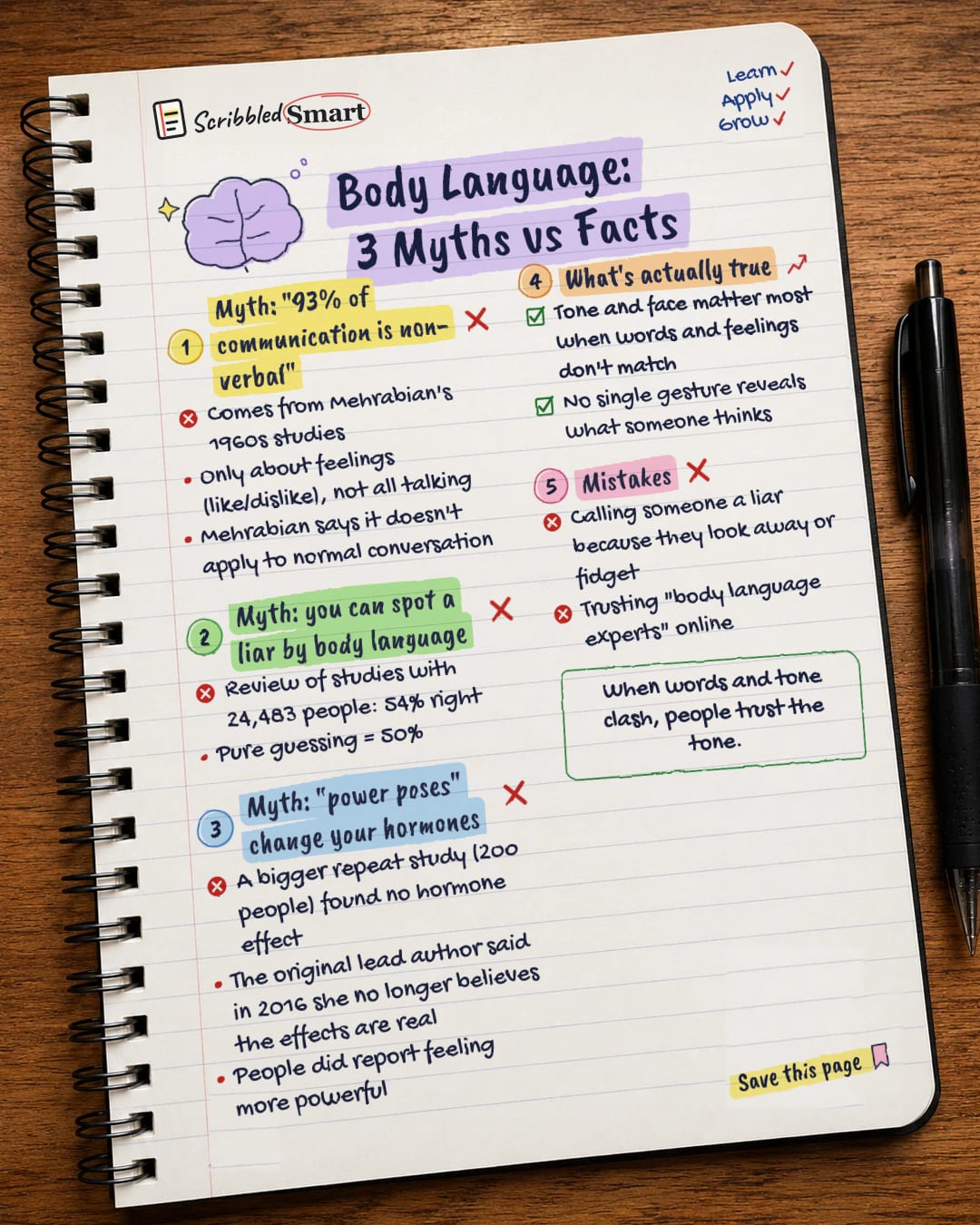
This is false for normal conversation. The figure, often called the "7-38-55 rule", comes from Albert Mehrabian's experiments in the 1960s, and those experiments were much narrower than the myth suggests.
What Mehrabian actually tested
His studies were about how people communicate feelings and attitudes, such as liking or disliking someone. They were not about all talking. In particular, they looked at messages where the words and the feelings didn't match.
Mehrabian has clarified this himself. He says the figures don't apply unless a person is talking about their feelings or attitudes. So the rule doesn't work for a meeting, a lecture or a chat about the weather.
What is true
When words and feelings clash, tone and face matter most. That is the narrow situation the experiments tested. In other words, when someone says "I'm fine" in a flat voice, people tend to trust the tone over the words.
Myth 2: can you spot a liar by their body language?
You can't, at least not reliably. On average, people do only slightly better than a coin toss.
The 54% finding
Bond and DePaulo published a large meta-analysis in 2006 in Personality and Social Psychology Review. A meta-analysis combines the results of many studies. Theirs covered 206 documents and 24,483 judges.
On average, people judged lies and truths correctly 54% of the time. Pure guessing would get 50%. That gap is small.
We tend to believe people
The same review found people caught only about 47% of lies. This is called a "truth bias": by default, we tend to believe what we are told.
There is no single "lying" gesture
A 2003 review by DePaulo and colleagues, "Cues to deception", looked at 158 possible signs of lying. Many behaviours showed no link, or only a weak link, to lying. That is why looking away or fidgeting is not proof of anything. It is also a good example of confirmation bias: once you suspect someone, every nervous gesture can seem to "fit".
Myth 3: do "power poses" change your hormones?
The hormone claim did not hold up when the original study was repeated with more people.
The bigger repeat study
In 2015, Ranehill and colleagues repeated the experiment with about 200 participants. The original study had 42. The larger study found no significant effect on hormones or behaviour.
One source mentions some partial results for cortisol and risk-taking. The main finding, which several sources agree on, was no hormone effect, and no testosterone effect in particular.
People did feel more powerful
One part did replicate. People who held power poses reported feeling more powerful. So the feeling seems real, even if the body changes were not.
What the original lead author said
In 2016, Dana Carney, the original study's lead author, said publicly: "I do not believe that 'power pose' effects are real." She pointed to small samples and the statistical methods used. This was not an admission of fraud, and it shouldn't be described that way.
A later analysis by Simmons and Simonsohn, using a method called p-curve, looked across the power-posing research. After allowing for selective reporting (only publishing the results that work), it found no evidence of an effect.
Why the myth spread so far
Amy Cuddy's TED talk on power posing is one of the most-viewed TED talks ever. That helps explain why so many people still believe it.
Beyond the body language myths: what it can really tell you
Body language can show how someone feels when their words and tone don't match. It can't read minds.
| Myth | What the research found |
|---|---|
| 93% of communication is non-verbal | Only true for mismatched messages about feelings |
| You can spot a liar by body language | 54% accuracy vs 50% for guessing |
| Power poses change your hormones | No hormone effect in a bigger repeat study |
Common mistakes to avoid
- Calling someone a liar because they look away or fidget. Many single cues have no link, or only a weak link, to lying.
- Trusting confident claims about reading people. In the research above, lie-spotting was barely better than guessing.
- Quoting "93%" in presentations or training. Mehrabian says it doesn't apply to normal conversation.
- Treating one gesture as a message. No single gesture reveals what someone thinks.
Related reading
- Introvert vs extrovert: another popular idea about people, checked against the evidence.
- How to prepare for a job interview: practical preparation that doesn't rely on power poses.
- How to spot a scam message: checking real evidence instead of trusting a gut feeling.
Sources
- Bond & DePaulo (2006): Accuracy of deception judgments (PDF)
- PubMed: Accuracy of deception judgments (16859438)
- Wikipedia: Albert Mehrabian
- Big Think: The 7-38-55 rule, debunked
- Wikipedia: Power posing
- BPS The Psychologist: Power posing
- University of Hertfordshire: The perils of power posing research
- FORRT Open Social Psychology, ch. 27: Power posing
- Europe PMC: DePaulo et al. (2003), Cues to deception
How we checked this
Every fact in this article comes from the 9 sources listed above, checked against official or peer-reviewed sources where possible. AI tools help with drafting; a person checks every fact against the sources. How we research
- Published and checked
General info, not professional advice.
Spotted a mistake? Tell us and we'll fix it and log it on the corrections page.


