
On this page
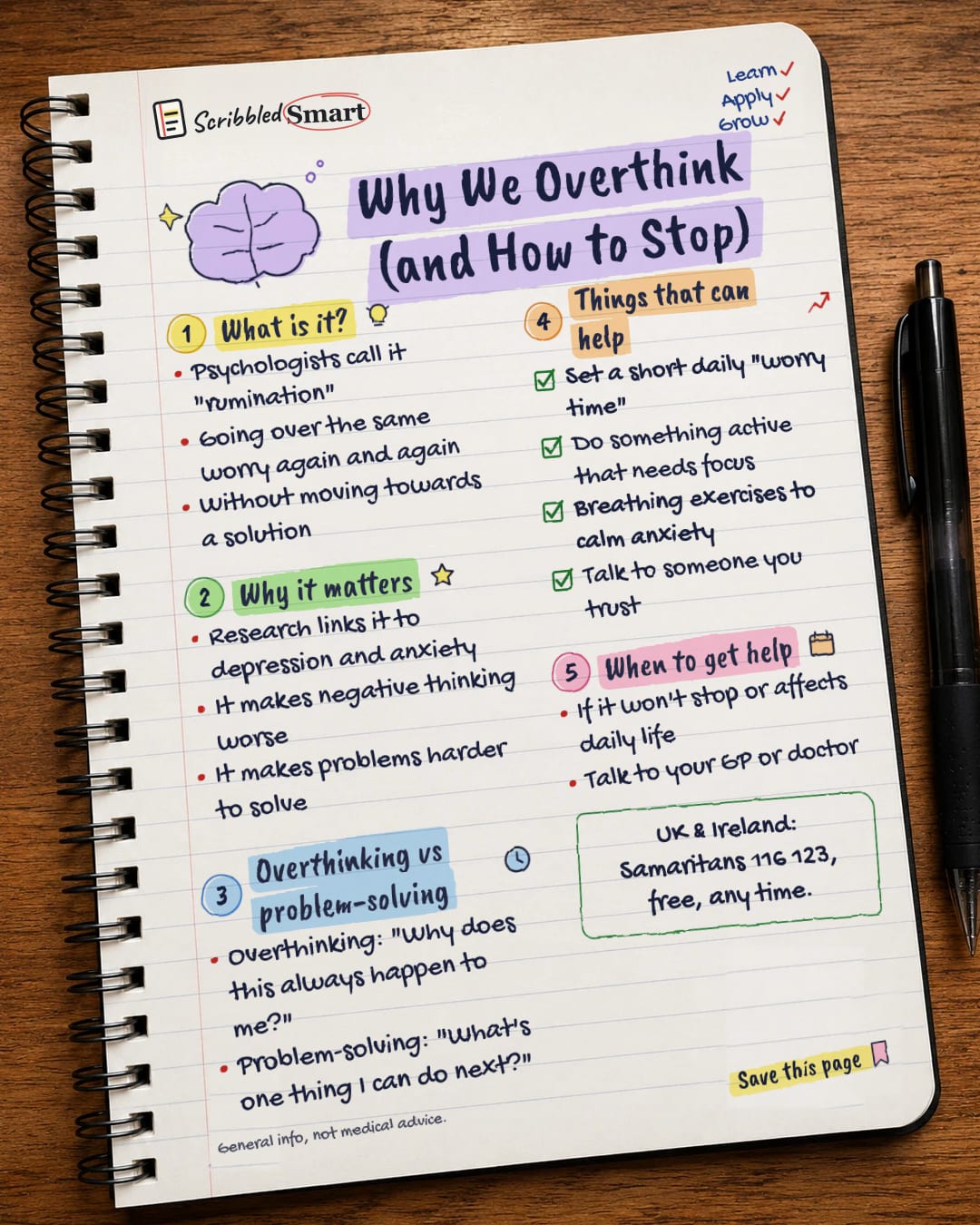
Overthinking is going over the same worry again and again without moving towards a solution, and psychologists call it "rumination". It feels like you are working on a problem, but research suggests it makes negative thinking worse and problems harder to solve. This article explains why overthinking matters, how it differs from real problem-solving, and some simple things that can help.
What is overthinking?
Overthinking is what psychologists call rumination: a repetitive, passive focus on distress. You go over the same worry again and again, without moving towards a solution.
The idea comes from the psychologist Nolen-Hoeksema. Her response styles theory (1991) described two ways people react to low mood: by ruminating on it, or by distracting themselves. Her 2008 review with Wisco and Lyubomirsky, "Rethinking Rumination", is a key paper on the topic.
Rumination vs worry
Both rumination and worry are forms of repetitive negative thinking. The difference is direction. Rumination looks back at the past ("Why did that happen?"). Worry looks ahead to the future ("What if it goes wrong?").
Is overthinking bad for you?
Overthinking isn't harmless thinking time. Research links it to real problems.
The "Rethinking Rumination" review says rumination "exacerbates depression, enhances negative thinking, impairs problem solving". That means it can make low mood worse, make negative thoughts stronger and make it harder to fix things.
The same review links rumination to depression and anxiety, and also to binge eating, drinking and self-harm.
How is overthinking different from problem-solving?
What separates them is whether your thinking leads to an action. Problem-solving moves you forward. Overthinking keeps you circling.
| Overthinking | Problem-solving |
|---|---|
| "Why does this always happen to me?" | "What's one thing I can do next?" |
| Passive: replays the problem | Active: looks for a next step |
| Leaves you feeling stuck | Leaves you with something to try |
The two example sentences are our own illustrations. They show the difference Nolen-Hoeksema drew between passive, ruminative thinking and action-focused thinking.
A quick test: after a while spent thinking about something, do you have a next step? If not, you may be overthinking rather than solving.
Things that can help with overthinking
You can't always stop a thought from arriving, but you can change what you do next. These ideas come from psychology research summaries, the NHS and Samaritans.
Set a short daily "worry time"
Give your worries a fixed slot. Nolen-Hoeksema suggested setting a time for this, for example 30 minutes. The NHS Every Mind Matters guidance on anxiety gives similar advice: if worry takes over your day, set a fixed time each day to go through your worries.
Switch to something absorbing
Activities that fully hold your attention can shift your focus away from the loop. Pick something that needs your full attention, rather than something you can do while still replaying the worry.
Slow your breathing
Samaritans' "Finding your way" guide suggests slow breathing to help calm stress and anxiety. The NHS also says breathing exercises and relaxation can help calm anxiety.
The ancient Stoics drew a similar line between what is and isn't up to us. Our one-page guide to Stoicism and what's up to you explains the idea.
Talk to someone you trust
Samaritans recommends talking to someone you trust.
Self-help based on CBT
The NHS says self-help based on cognitive behavioural therapy (CBT) can help with worries and unhelpful thoughts. Every Mind Matters links to free CBT self-help techniques.
When to get help
If overthinking won't stop, or it affects your sleep and daily life, talk to your GP or doctor. A GP is a family doctor in the UK.
🇬🇧 UK: the NHS says to contact NHS 111 or talk to a GP if anxiety affects your daily life. 🇬🇧 England only: you can refer yourself for free NHS talking therapies without seeing a GP.
Need to talk right now?
🇬🇧 UK and Republic of Ireland: Samaritans, 116 123. It's free from any phone and open any time, 24 hours a day, 365 days a year.
Outside the UK and Ireland? Search for your country's crisis line.
This page is general information. It isn't a treatment for anxiety or depression.
Common overthinking mistakes
- Thinking more will fix it. Rumination makes problem-solving harder, not easier.
- Treating every "why" as progress. If thinking doesn't lead to a next step, it's probably a loop.
- Waiting too long to talk to someone. If it's affecting sleep or daily life, speak to your GP or doctor.
Our guide to why we procrastinate looks at another way our thinking can keep us stuck.
Related reading
- Stress and your body: what stress does physically, and why calming your body helps.
- Why writing a plan calms your mind: turning a loop of worry into a list of next steps.
- Signs of burnout: when worry is tied to long-term stress at work.
Sources
- PubMed: Nolen-Hoeksema, Wisco & Lyubomirsky (2008), Rethinking Rumination
- Psychology Today: 9 strategies for overcoming overthinking
- Simply Psychology: How rumination makes anxiety worse
- Samaritans: Finding your way (PDF)
- Samaritans: Contact us
- Mind: Mental health helplines
- NHS Every Mind Matters: Anxiety
How we checked this
Every fact in this article comes from the 7 sources listed above, checked against official or peer-reviewed sources where possible. AI tools help with drafting; a person checks every fact against the sources. How we research
- Published and checked
- Next check
- Helpline details yearly
General info, not medical advice. UK and Ireland: Samaritans 116 123, free, any time.
Spotted a mistake? Tell us and we'll fix it and log it on the corrections page.


