
On this page
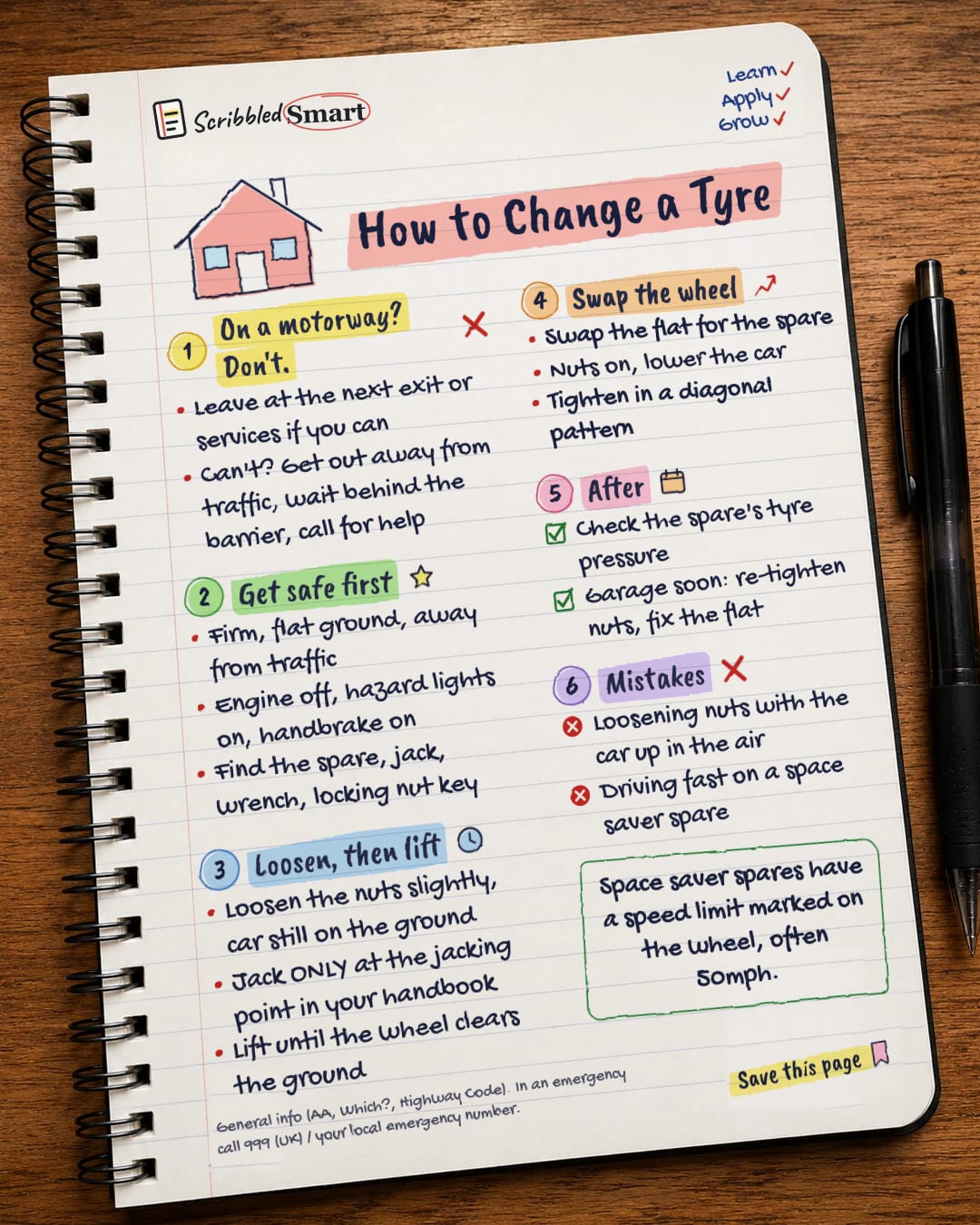
This is how to change a tyre: get somewhere safe and flat, loosen the wheel nuts while the car is still on the ground, jack the car up at the correct jacking point, swap the flat for the spare, then lower the car and tighten the nuts in a diagonal pattern. But first, know when not to do it at all. On a motorway, you should not change a tyre yourself. This guide follows the AA's step-by-step advice, Which? and the Highway Code.
If you are in danger, call 999 (UK) or your local emergency number.
Can you change a tyre on a motorway?
If you get a flat on a motorway, don't try to change it. The AA advises not changing a tyre on the side of a motorway or on a hard shoulder. 🇬🇧 In the UK, Highway Code rule 277 says do not attempt repairs on your vehicle.
What to do instead, from the UK Highway Code:
- Leave the carriageway at the next exit, or pull into a service area, if possible.
- If you can't, get out by the side furthest from traffic, if it is safe and possible to do so.
- Get behind a safety barrier where there is one.
- Call for help, for example your breakdown provider.
Step 1: Get safe before you start
The first job is to make the car and yourself safe. Only then think about the wheel.
- Firm, flat ground, away from traffic. The AA says move to a safe place away from traffic and use a level surface.
- Engine off, hazard lights on.
- Handbrake on, and put the car in park or first gear.
- Find your kit: the spare wheel, the jack, the wheel wrench and the locking wheel nut key. Which? notes the locking wheel nut adapter is usually stored with the jack.
The AA recommends having two people if possible, as it is a tricky job.
No spare wheel?
Many new cars have no spare, only a tyre repair kit. This guide doesn't cover repair kits, so check your car's handbook.
Step 2: Loosen the nuts, then lift the car
Order matters here. Loosen first, lift second.
- Loosen the wheel nuts slightly while the car is still on the ground. The AA says this needs to be done before lifting the car, as a safety measure.
- Find the jacking point. Use only the jack point shown in your car's manual.
- Lift the car until the wheel clears the ground.
Step 3: Swap the wheel
With the car lifted, the swap itself is quick.
- Remove the nuts and take off the flat wheel. A car wheel is heavy, so Which? says lift it with care. If the wheel won't come off, the AA says call for help.
- Fit the spare wheel.
- Put the nuts back on and secure them.
- Lower the car onto the tyre.
- Tighten the nuts fully, ideally in a diagonal pattern.
Step 4: What should you do after changing a tyre?
The job is not quite finished when the spare is on.
- ✓ Check the spare's tyre pressure.
- ✓ Visit a garage soon. They can re-tighten the nuts to the manufacturer's torque (the correct tightness) and fix or replace the flat.
Space saver spares have a speed limit
If your spare is a "space saver", it has its own speed limit. Which? says its speed limit will normally be marked on the wheel rim, typically 50mph. The AA also says there is usually a 50mph restriction. Check the rim of yours and keep to it.
How to change a tyre without the common mistakes
Avoid these four slip-ups.
- ✗ Loosening the nuts with the car up in the air. Do it on the ground first.
- ✗ Driving fast on a space saver spare. Keep to the limit marked on the wheel.
- ✗ Changing a tyre on a motorway or hard shoulder. Get to safety and call for help instead.
- ✗ Jacking anywhere other than the jacking point. Your handbook shows where it is.
A flat tyre is a good reminder to keep some money aside for surprises. Our guide to why an emergency fund matters explains how to build one.
Related reading
- First aid basics: what to do if someone is hurt at the roadside.
- Travel checklist (UK): getting ready for a trip, by car or plane.
- How to spot a scam message: useful if you get an unexpected "breakdown cover" text.
Sources
- AA: How to change a flat tyre (updated 7 Aug 2024)
- Which?: How to change a car tyre or use a repair kit (6 Jul 2026)
- GOV.UK: The Highway Code, breakdowns and incidents (rules 274 to 287)
How we checked this
Every fact in this article comes from the 3 sources listed above, checked against official or peer-reviewed sources where possible. AI tools help with drafting; a person checks every fact against the sources. How we research
- Published and checked
🇬🇧 Highway Code rules apply in the UK; the changing steps are general. General info (AA, Which?, Highway Code), not a substitute for your car's handbook. In an emergency call 999 (UK) / your local emergency number.
Spotted a mistake? Tell us and we'll fix it and log it on the corrections page.


