
On this page
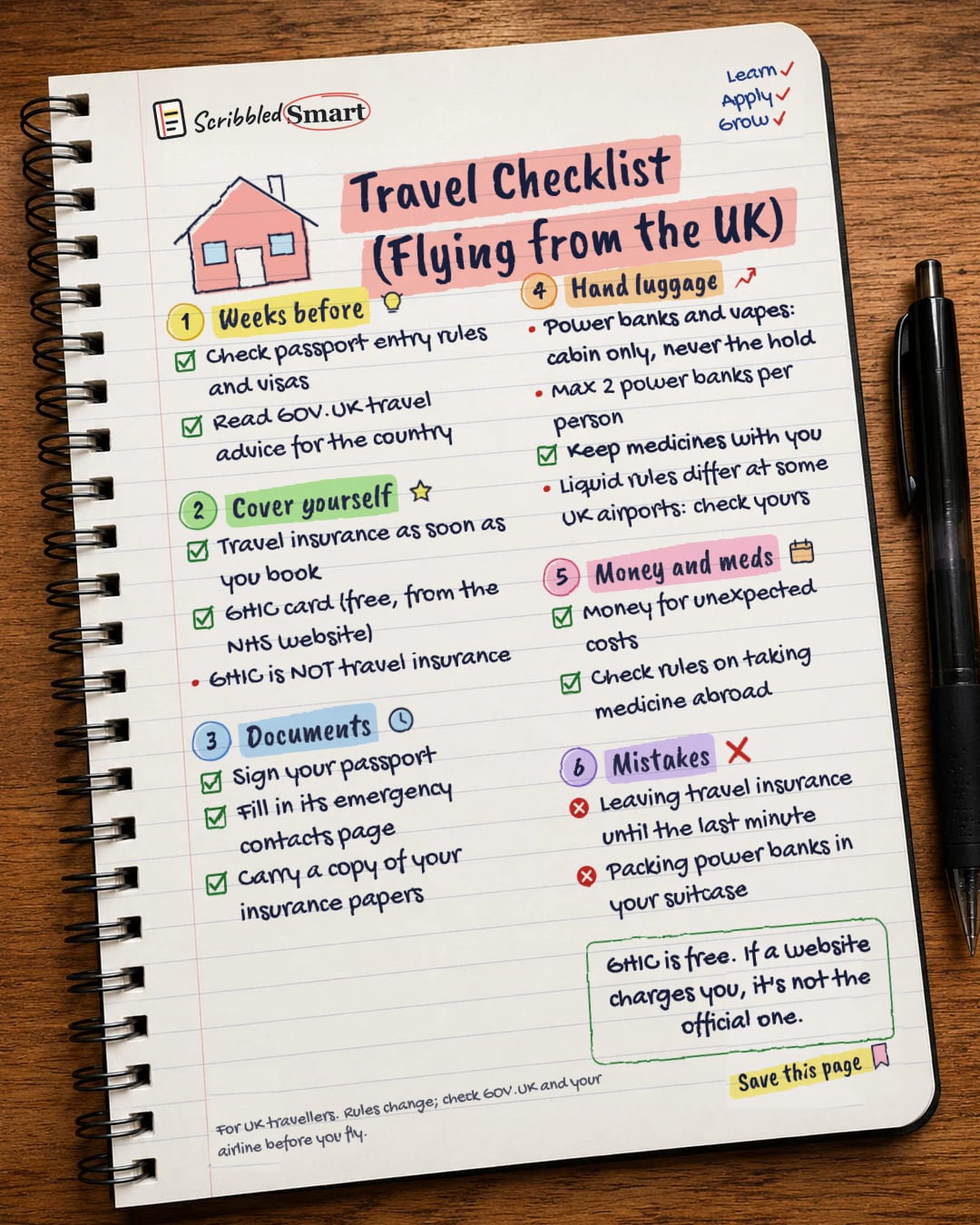
This travel checklist UK travellers can use before flying comes down to four things: check your passport and visa rules, buy travel insurance as soon as you book, get a free GHIC card, and pack power banks and medicines in your hand luggage. This guide goes through each one, using GOV.UK, NHS and Civil Aviation Authority (CAA) guidance.
🇬🇧 For UK travellers. Rules as of November 2026. Rules change, so check GOV.UK and your airline before you fly.
Weeks before you go: passport, visa and travel advice
Start with the rules for the country you are visiting. They decide whether you can travel at all.
- Check your passport meets the entry requirements for the country you are visiting.
- Get the correct visa for your destination, if you need one.
- Read the GOV.UK foreign travel advice for that country. This is published by the Foreign, Commonwealth and Development Office (FCDO).
Why we don't give a passport validity rule
You may see rules online about how old your passport can be, or how many months it must be valid after you return. Different GOV.UK pages describe these rules in different ways for different countries. So rather than give one rule that may be wrong for your trip, we suggest checking the entry rules on the GOV.UK page for the country you are going to.
When should you buy travel insurance, and do you need a GHIC?
Get travel insurance as soon as you book your trip, and apply for a free GHIC as well. They do different jobs.
Travel insurance
GOV.UK advises getting appropriate travel insurance as soon as you book, so don't leave it to the last minute.
GHIC (Global Health Insurance Card)
A UK GHIC is free and lasts for up to 5 years. You apply on the NHS website. The NHS says it also works in some places outside the EEA, such as Australia and Montenegro. In Switzerland, it only works for some people.
Two things to know:
- GHIC is not travel insurance. The NHS says the UK GHIC is not a replacement for travel insurance. You still need both.
- Never pay for it. The NHS warns people to avoid unofficial websites, which may charge you a fee to apply. If a website charges you, it is not the official one.
Documents to sort before you leave
A few minutes with your passport and paperwork now can save a lot of stress abroad.
- ✓ Sign your passport.
- ✓ Fill in the emergency contacts page in your passport.
- ✓ Print your insurance documents and carry a copy with you.
What should go in your hand luggage?
Some items must stay with you in the cabin. Others depend on your airport.
Power banks and vapes
The CAA says always keep vapes and power banks with you in the cabin. Never put them in your hold luggage (the suitcase you check in). You can only take two power banks per person. The CAA also says to check that your power banks meet your airline's own size and quantity limits.
Medicines
Keep essential items such as medicine in your hand luggage, as the CAA advises. That way they stay with you for the whole journey.
Liquids
GOV.UK says the rules for taking liquids through security in your hand luggage have changed at some UK airports. The GOV.UK air travel checklist still mentions a 100ml limit, but some airports with new scanners have different limits. Because it depends on the airport, check with yours before you pack.
Money and medicines abroad
Plan for the unexpected before you leave home.
- ✓ Make sure you can get money for unexpected costs.
- ✓ Check the rules on taking medicine abroad. GOV.UK lists this on its foreign travel checklist.
On the day
GOV.UK's air travel checklist says don't arrive earlier than your airline's earliest advised time.
Travel checklist UK: common mistakes
These three slip-ups are easy to avoid.
- ✗ Leaving travel insurance until the last minute. GOV.UK says get it as soon as you book.
- ✗ Packing power banks in your suitcase. They go in the cabin only.
- ✗ Paying a website for a GHIC. The official card is free.
Before a big trip, it also helps to have some savings set aside. Our guide to building an emergency fund explains how.
Related reading
- Moving house: who to tell: another UK checklist for a big life change.
- Spotting scam messages: useful if you get a suspicious text about your booking or GHIC.
- Inflation explained: why your holiday money may not go as far as last year.
Sources
- GOV.UK: Foreign travel checklist
- GOV.UK: Air travel checklist for travel from the UK
- GOV.UK: Hand luggage restrictions at UK airports
- NHS: Apply for a free UK Global Health Insurance Card (GHIC)
- CAA: Pack right. Safe flight.
- CAA: Changes to rules on lithium batteries and power banks
How we checked this
Every fact in this article comes from the 6 sources listed above, checked against official or peer-reviewed sources where possible. AI tools help with drafting; a person checks every fact against the sources. How we research
- Published and checked
- Next check
- Every 6 months (EU entry systems, airport liquid rules and battery rules are changing).
🇬🇧 For UK travellers. Rules change; check GOV.UK and your airline before you fly. General info, not legal advice.
Spotted a mistake? Tell us and we'll fix it and log it on the corrections page.


