
On this page
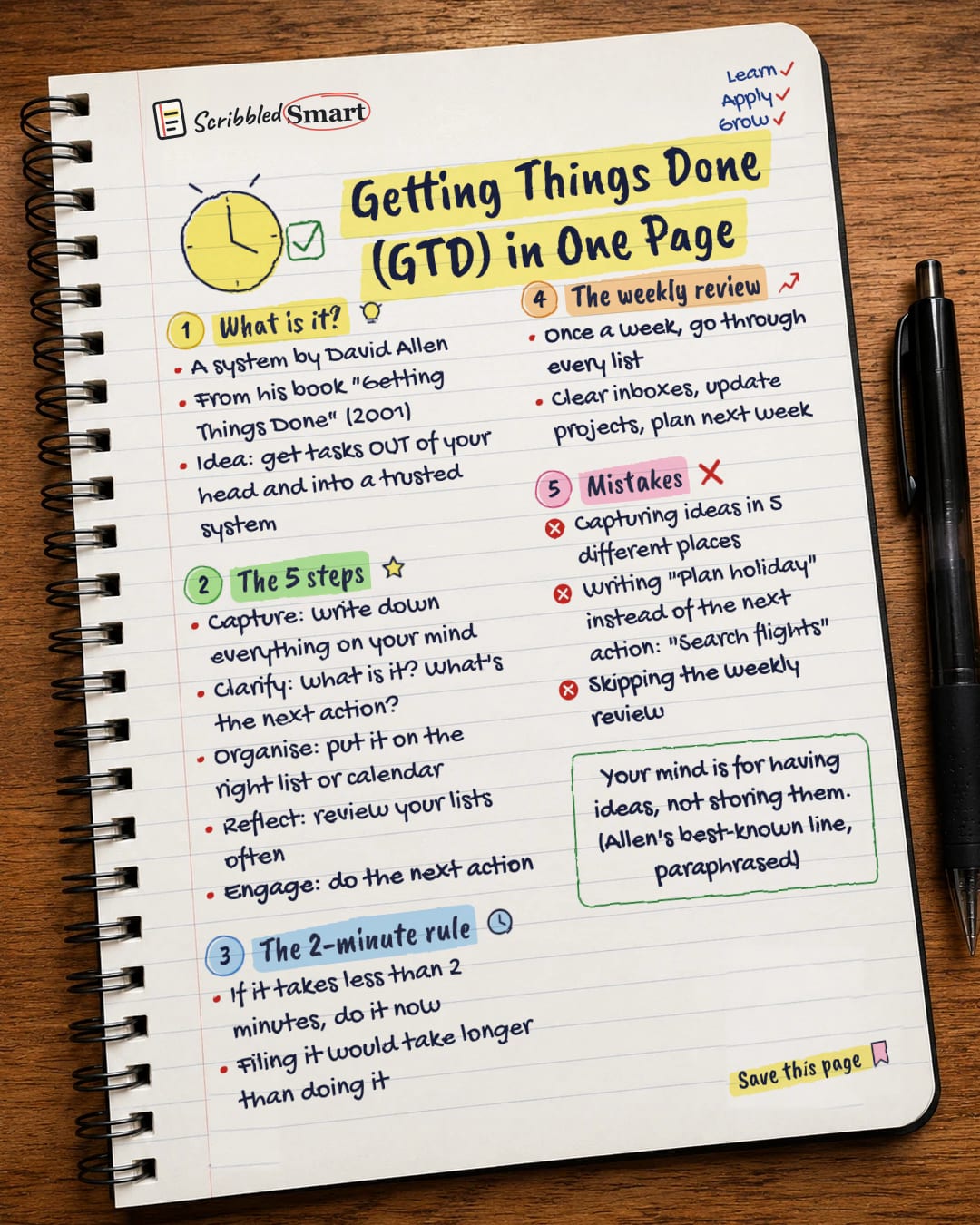
Getting Things Done, or GTD, is a personal organisation system by David Allen that gets tasks out of your head and into a system you trust. It works through five steps: capture, clarify, organise, reflect and engage. This guide walks through each step, the famous 2-minute rule, the weekly review, and the mistakes that stop GTD from working.
What is Getting Things Done?
Getting Things Done is a method for managing everything you need to do. It comes from David Allen's book Getting Things Done: The Art of Stress-Free Productivity, first published in 2001 and revised in 2015.
The core idea is simple. Instead of trying to remember every task, you get it out of your head and into a trusted system: lists, a calendar, a notebook or an app. Then your mind is free to focus on doing.
One line sums this up: "Your mind is for having ideas, not holding them." The David Allen Company lists that exact phrase among its registered trademarks.
To be clear, GTD is a method, not a research finding. For research on why writing tasks down can help, see our article on how making a plan calms your mind.
What are the 5 steps of GTD?
The five steps take a task from "something on your mind" to "done". The official names are Capture, Clarify, Organize, Reflect and Engage.
| Step | What you do |
|---|---|
| Capture | Collect everything that has your attention |
| Clarify | Decide what each item is and what the next action is |
| Organise | Put it on the right list or in your calendar |
| Reflect | Review your lists often |
| Engage | Do the next action |
1. Capture
Write down everything on your mind. Big projects, small chores, ideas, worries. If it has your attention, it goes in.
2. Clarify
Go through each item and ask: what is it? Is there anything I need to do? If so, what's the very next action?
3. Organise
Put each item where it belongs. Tasks go on the right list. Things with a fixed date go in your calendar.
4. Reflect
Look over your lists often, so you trust that nothing has slipped through.
5. Engage
Pick the next action and do it.
Older step names
If you read the first edition, the steps had different names: collect, process, organise, review and do.
What is the 2-minute rule in GTD?
The 2-minute rule says that if a task takes less than 2 minutes, you should do it now. David Allen explains the logic on the official GTD site: looking at the task again and reviewing it later would take you longer than two minutes. He adds one condition: do it right then only if you need to do it at all.
Replying "yes, Thursday works" to a message is a classic 2-minute task. Writing a report is not.
The weekly review
The weekly review is a regular check of your whole system, once a week. "GTD Weekly Review" is a trademark of the David Allen Company. Guides to the method describe it like this:
- Go through every list.
- Clear your inboxes.
- Update your projects.
- Plan the week ahead.
Without it, lists can go stale and become hard to trust. Once that happens, tasks drift back into your head.
Common Getting Things Done mistakes
- Capturing ideas in 5 different places. Notes app, sticky notes, emails to yourself, a notebook, a whiteboard. Pick as few places as you can, so nothing gets lost.
- Writing the project instead of the next action. "Plan holiday" is vague. "Search flights" is something you can actually do.
- Skipping the weekly review. This is the step that keeps the system trustworthy.
FAQ
Who created Getting Things Done?
David Allen created it. He set out the system in his book Getting Things Done: The Art of Stress-Free Productivity, first published in 2001 and revised in 2015. The David Allen Company now runs the official GTD website and describes the five steps there.
What is the 2-minute rule in GTD?
The 2-minute rule says that if a task will take less than 2 minutes, do it straight away. Filing it and coming back later would take longer than simply doing it. David Allen explains the rule on the official GTD website, and adds that it only applies to things you need to do at all.
What is a GTD weekly review?
The weekly review is a once-a-week check of your whole GTD system. You go through every list, clear your inboxes, update your projects and plan the week ahead. It keeps your lists current, so you can trust them instead of trying to hold everything in your head.
Related reading
- The Eisenhower Matrix: a quick way to decide which next action matters most.
- Time blocking: turn your GTD lists into a realistic calendar plan.
- Why we overthink: more on busy minds and how to quieten them.
Sources
- David Allen Company: What is GTD?
- David Allen Company: Five steps
- Graham Mann: GTD book notes
- Asana: Getting Things Done
- Thomas Frank: 5-minute guide to GTD
- David Allen Company: The Two-minute Rule (podcast transcript)
How we checked this
Every fact in this article comes from the 6 sources listed above, checked against official or peer-reviewed sources where possible. AI tools help with drafting; a person checks every fact against the sources. How we research
- Published and checked
Spotted a mistake? Tell us and we'll fix it and log it on the corrections page.


