
On this page
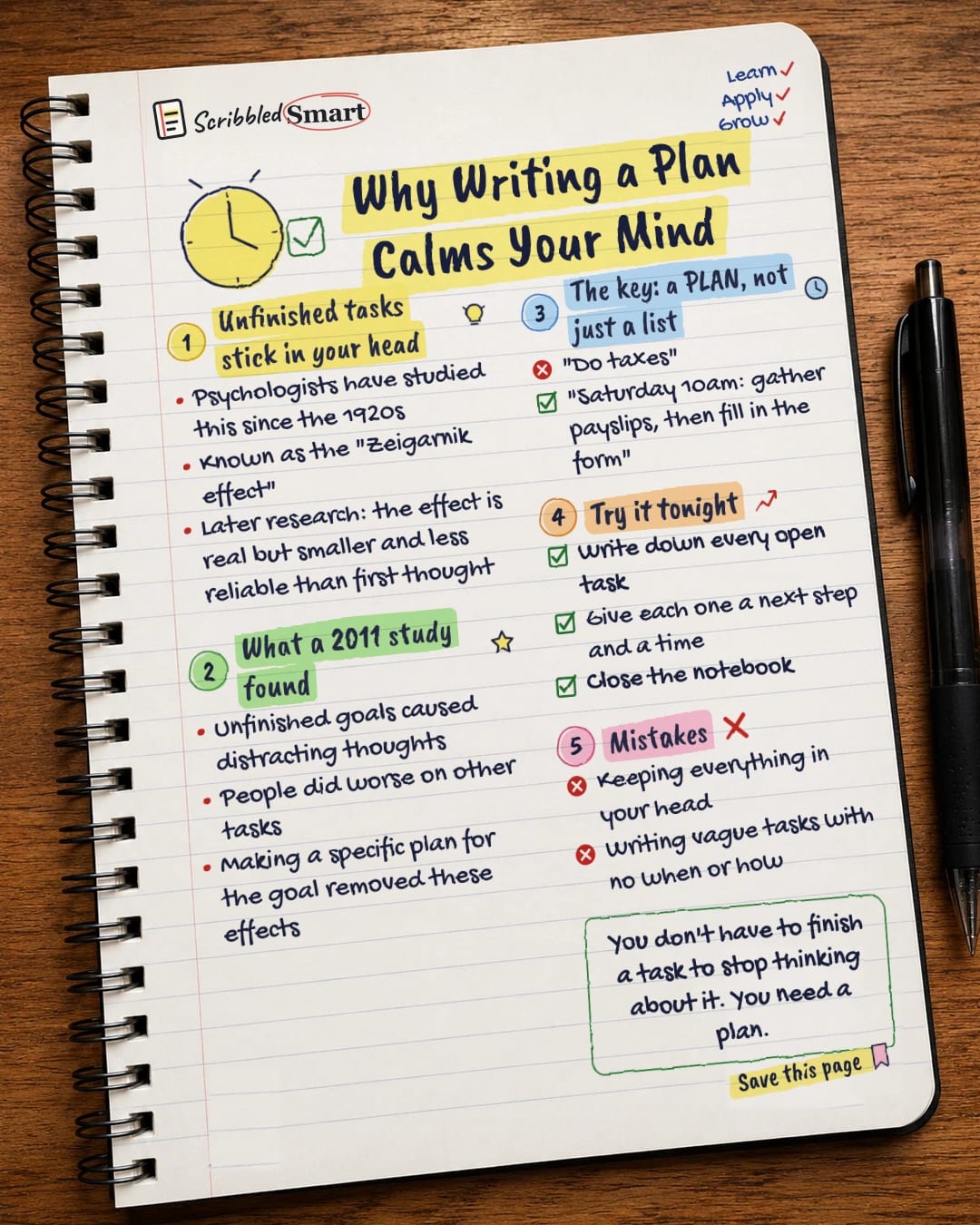
The Zeigarnik effect is the old idea that unfinished tasks stay stuck in your mind more than finished ones. Newer research suggests the memory part is weaker than once thought, but unfinished goals can still cause distracting thoughts. A 2011 study found that making a specific plan for a goal removed those effects, even before the task was done.
What is the Zeigarnik effect?
The Zeigarnik effect is the claim that we remember unfinished tasks better than finished ones, because they stay "active" in the mind. It's named after psychologist Bluma Zeigarnik, who studied it in 1927.
You might recognise the feeling. You lie in bed and your mind keeps listing the jobs you haven't done.
Is the Zeigarnik effect real?
The memory part of the Zeigarnik effect has not held up well. As early as 1951, the researcher Hovland noted that few investigators could clearly reproduce Zeigarnik's findings.
A meta-analysis published in 2025 by Ghibellini and Meier, at the University of Bern, pulled together the research. It found:
| Effect | What it claims | What the meta-analysis found |
|---|---|---|
| Zeigarnik effect | We remember unfinished tasks better | No general memory advantage |
| Ovsiankina effect | We tend to go back to unfinished tasks | A general tendency to resume them |
The authors concluded that the Zeigarnik effect doesn't apply universally. They suggested that factors such as the experimenter's authority, the demands of the task and how involved people were may explain why older studies sometimes found it.
So unfinished tasks may not be better remembered. But they do seem to tug at us, pulling us back to them.
What a 2011 study found about unfinished goals
Unfinished goals can get in the way of other work. That's what Masicampo and Baumeister found in a 2011 study in the Journal of Personality and Social Psychology, titled "Consider it done! Plan making can eliminate the cognitive effects of unfulfilled goals".
The problem: distracting thoughts
When people had an unfinished goal on their mind, the study found:
- Intrusive thoughts about the goal while they were trying to read.
- Words linked to the goal stayed unusually easy to bring to mind.
- Worse performance on an unrelated task (solving anagrams).
The fix: a specific plan
When people made a specific plan for their unfinished goal, those effects disappeared. They didn't need to finish the task. They just needed a clear plan for it.
What the study doesn't show
Two limits matter here. The study was done in lab settings with students. And, as Psychology Today points out, planning reduced intrusive thoughts, not anxiety about unfinished tasks. So "calms your mind" here means fewer distracting thoughts, not less worry overall.
Does writing a to-do list help? Make a plan, not just a list
A list names the task. A plan says when and how you'll do it. That difference is what the 2011 study points to.
| Just a list | A specific plan |
|---|---|
| "Do taxes" | "Saturday 10am: gather payslips, then fill in the form" |
| "Call the dentist" | "Tuesday lunch: ring the dentist to book a check-up" |
| "Sort the garage" | "Sunday 2pm: clear the top shelf first" |
You don't have to finish a task to stop thinking about it. You need a plan.
Try it tonight
All you need is a notebook and a pen.
- Write down every open task that's on your mind.
- Give each one a next step and a time. What exactly will you do, and when?
- Close the notebook. Your plan is safe on paper.
If you want a whole system built on this idea, David Allen's Getting Things Done method starts by capturing everything on your mind.
Common mistakes with unfinished tasks
- Keeping everything in your head. That's where unfinished goals can cause distracting thoughts.
- Writing vague tasks with no when or how. "Do taxes" is a reminder, not a plan.
- Expecting a plan to remove all worry. The study found fewer intrusive thoughts, not less anxiety.
FAQ
What is the Zeigarnik effect in simple terms?
The Zeigarnik effect is the idea that unfinished tasks stick in your mind better than finished ones. It's named after Bluma Zeigarnik, who studied it in 1927. A 2025 meta-analysis found no general memory advantage for unfinished tasks, though people do tend to go back to interrupted tasks.
Why can't I stop thinking about unfinished tasks?
Research suggests unfinished goals can trigger intrusive thoughts. In a 2011 study by Masicampo and Baumeister, people with an unfinished goal had more distracting thoughts while reading and did worse on an unrelated task. Making a specific plan for the goal removed those effects, without needing to finish it.
What is the Ovsiankina effect?
The Ovsiankina effect is the tendency to go back to, or resume, a task that was interrupted. A 2025 meta-analysis by Ghibellini and Meier found this tendency held up as a general pattern, while the Zeigarnik effect, the claimed memory advantage for unfinished tasks, did not.
Related reading
- Why we overthink: more on looping thoughts and how to break them.
- Sleep better with the NHS basics: simple habits for a better night's sleep.
- Why we procrastinate: how if-then plans make it easier to start.
Sources
- PubMed: Masicampo & Baumeister (2011), Consider it done!
- Psychology Today: Why your to-do list drives you crazy
- Simply Psychology: Zeigarnik effect
- IDEAS/RePEc: Ghibellini & Meier (2025), meta-analysis of the Zeigarnik and Ovsiankina effects
How we checked this
Every fact in this article comes from the 4 sources listed above, checked against official or peer-reviewed sources where possible. AI tools help with drafting; a person checks every fact against the sources. How we research
- Published and checked
Spotted a mistake? Tell us and we'll fix it and log it on the corrections page.


