
On this page
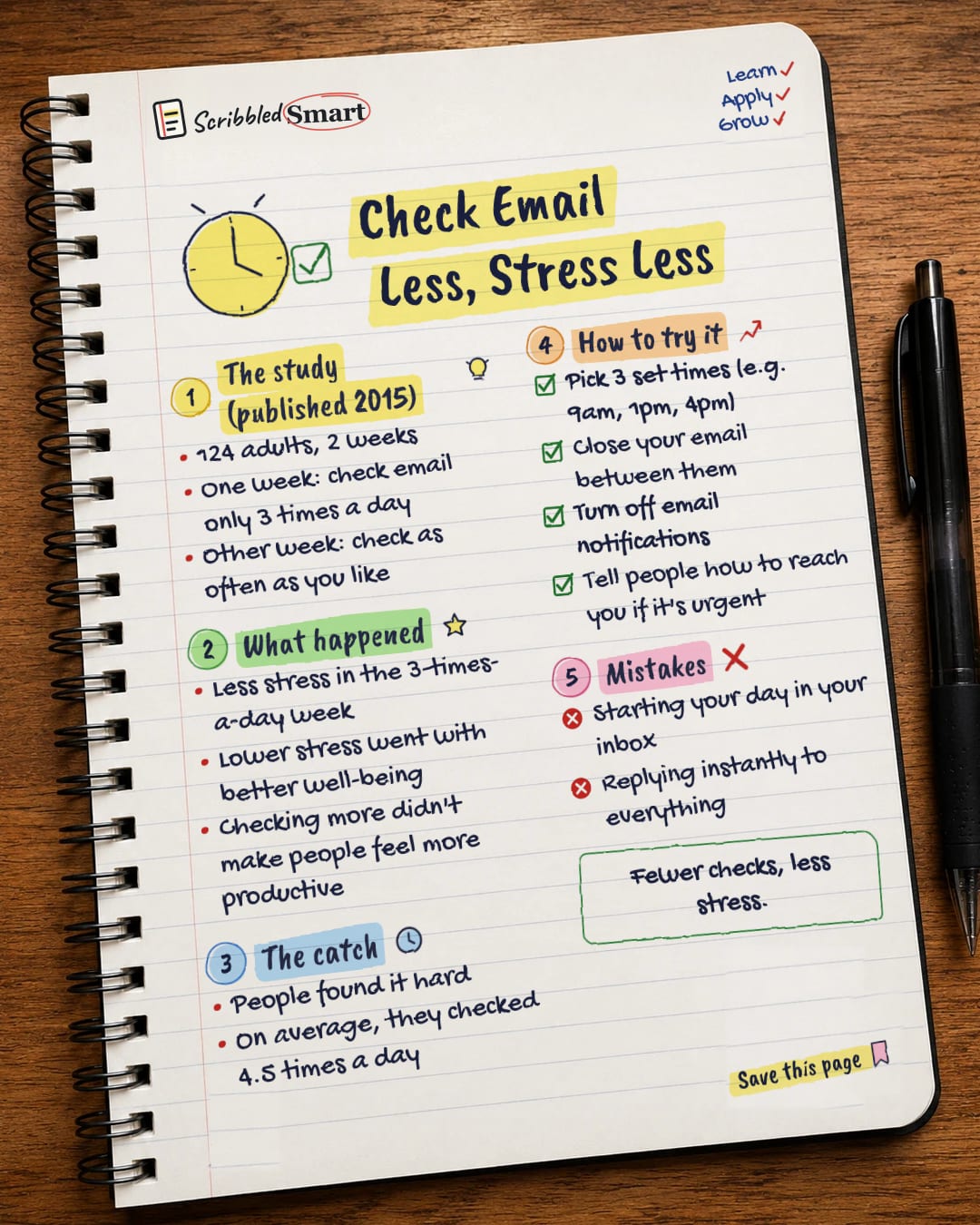
When you check email less, you may feel less stressed. That was the main finding of a 2015 study in which 124 adults spent one week checking email only three times a day, and another week checking as often as they liked. This article covers how the experiment worked, what changed, the catch, and how to try it yourself.
How was the email study set up?
The study tested whether limiting email checks changes how stressed people feel. It was run by Kushlev and Dunn at the University of British Columbia and published in 2015 in the journal Computers in Human Behavior, under the title "Checking email less frequently reduces stress".
Here's how it worked:
| Limited week | Unlimited week | |
|---|---|---|
| How often to check | 3 times a day | As often as you like |
| Email program | Closed between checks | Open as usual |
| Notifications | Off | As usual |
The 124 adults took part for two weeks. Each person did one week of each, so everyone could be compared with themselves. Researchers call this a crossover design.
Does checking email less reduce stress?
People felt less stressed in the week they checked email only three times a day. The study found lower daily stress in the limited week.
Two other findings stand out:
- Lower stress went with better well-being. In the study, lower stress predicted higher well-being.
- Checking more didn't make people feel more productive. Press coverage of the study reported this.
So the constant checking that feels productive didn't come with a sense of getting more done.
Is it hard to check email only 3 times a day?
Limiting email was not easy for the people in the study. In the University of British Columbia's news story, the lead author said most participants found it quite difficult to check only a few times a day. New Republic's report adds that in the limited week people checked about 4.5 times a day on average, not 3.
That's useful to know before you try it. If you slip, you're not alone. The goal is to check less, not to be perfect.
Limits of the study
Keep a few things in mind:
- One sample of 124 adults. About two-thirds were university students; the rest worked in fields such as health care, academia, finance and IT.
- Not every job fits. Some roles, such as customer support, may need people to answer quickly.
- It measured stress, not output. The study looked at how people felt, not how much work they actually produced.
How to check email less: a simple routine
Start with set times and fewer alerts. These tips copy what the study asked people to do, plus a few practical steps.
- Pick 3 set times. For example, 9am, 1pm and 4pm.
- Close your email between them. That's what people did in the study's limited week.
- Turn off email notifications. No pings, no pull.
- Tell people how to reach you if it's urgent. A phone number or chat channel for real emergencies takes the pressure off.
Why fewer checks may help focus too
Each email check is a switch away from what you were doing. Our guide to why task switching costs you time explains how those small jumps add up.
Email mistakes to avoid
- Starting your day in your inbox. Your first hours go on other people's requests instead of your own plan.
- Replying instantly to everything. Messages that aren't urgent can wait until your next set check.
- Leaving email open all day "just in case". In the study, the limited week had the program closed between checks.
FAQ
How many times a day should you check email?
There's no single right number for everyone. In a 2015 study, 124 adults felt less daily stress in a week when they checked email only three times a day than in a week of unlimited checking. Three set times, such as 9am, 1pm and 4pm, is a simple place to start.
Does checking email less make you less productive?
The study didn't measure actual output, only how people felt. Press coverage reported that checking more often didn't make people feel more productive. So frequent checking may feel busy without giving you a stronger sense of getting things done.
Should I turn off email notifications?
In the 2015 study, people in the limited week turned off email notifications and kept their email program closed between checks, and they reported less stress. Turning off notifications is a simple way to copy that setup. If your job needs quick replies, tell people how to reach you urgently.
Related reading
- Deep work: why batching shallow tasks like email protects your focus.
- Stress and your body: what stress actually does to you.
- Signs of burnout: when work stress builds up, what to look out for.
Sources
- Kushlev & Dunn (2015): Checking email less frequently reduces stress (manuscript PDF)
- UBC Psychology: Checking your email less can help reduce stress
- ScienceDaily (2014): Checking email less frequently reduces stress
- New Republic: You'll be less stressed if you check your email less frequently
- PsyPost: Resist temptation, check email less to reduce stress
How we checked this
Every fact in this article comes from the 5 sources listed above, checked against official or peer-reviewed sources where possible. AI tools help with drafting; a person checks every fact against the sources. How we research
- Published and checked
Spotted a mistake? Tell us and we'll fix it and log it on the corrections page.


