
On this page
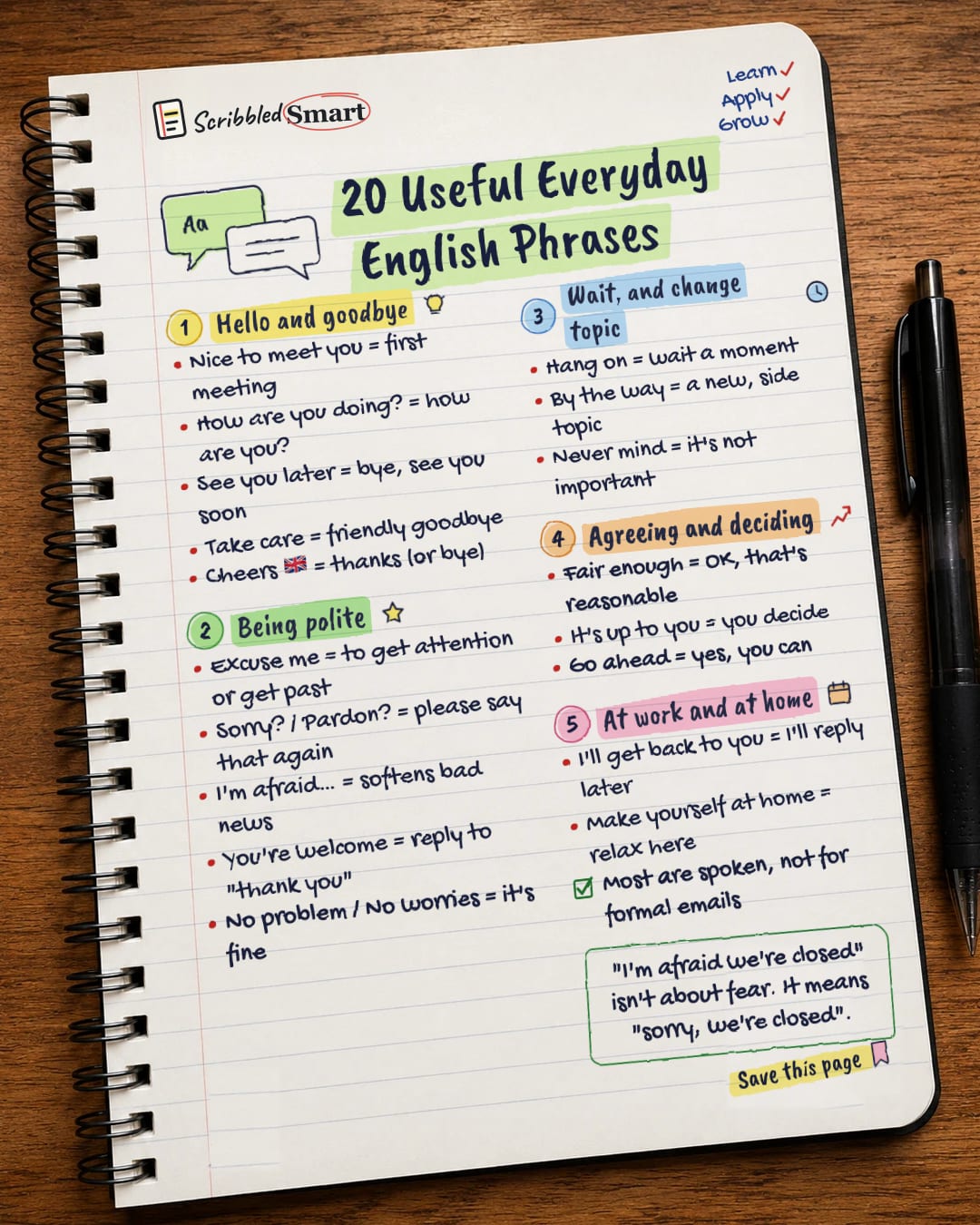
Everyday English phrases are the short, mostly spoken expressions people use to say hello, be polite, agree and change the subject, such as "nice to meet you", "never mind" and "fair enough". Knowing them helps you understand conversations and sound natural. Here are 20 useful ones, grouped by situation, with plain meanings based on the Longman Dictionary of Contemporary English.
How do you say hello and goodbye in English?
These five phrases cover meeting, greeting and leaving.
| Phrase | Meaning |
|---|---|
| Nice to meet you | a friendly greeting when you meet someone for the first time |
| How are you doing? | asking if someone is well and happy (spoken) |
| See you later | goodbye, when you know you'll see them again |
| Take care | a friendly goodbye to family and friends (spoken) |
| Cheers 🇬🇧 | thank you, or goodbye (British English, informal) |
Examples:
- "Hi, I'm Sara." "Nice to meet you, Sara."
- "Cheers for the lift. See you later!"
The Longman Dictionary explains that "see you later" can mean "see you soon" or "see you later the same day".
Being polite
These phrases help you ask, apologise, thank and soften what you say.
Excuse me
The dictionary gives two everyday uses: to get someone's attention politely, and to ask someone politely to move so you can walk past.
- Excuse me, is this seat free?
- Excuse me, can I just get past?
The Longman Dictionary lists other uses too, such as leaving politely or disagreeing politely. Saying "Excuse me?" to ask someone to repeat something is labelled "especially American English".
Sorry? / Pardon?
Both ask someone to repeat something you didn't hear properly.
- "The meeting's at four." "Sorry? I didn't catch that."
I'm afraid…
This phrase politely tells someone something that may annoy, upset or disappoint them. It has nothing to do with being scared. The Longman Dictionary labels it spoken.
- I'm afraid we're closed. (= Sorry, we're closed.)
- I'm afraid I can't come tonight.
You're welcome
A polite reply when someone has just thanked you.
- "Thanks for your help." "You're welcome."
No problem / No worries
"No problem" can show you're happy to do something, or answer someone who has said thank you or sorry. The Longman Dictionary says "no worries" is used to agree to what someone wants and say it will be no problem. It labels "no worries" British English, spoken.
- "Could you send me the photos?" "No worries."
How do you pause a chat or change the topic?
These three help you pause a conversation or move it along.
| Phrase | Meaning | Example |
|---|---|---|
| Hang on | wait a moment (British English, spoken) | Hang on, I'll get my coat. |
| By the way | introduces something not related to the main topic | By the way, did you see the match? |
| Never mind | don't worry; it's not important now | Never mind, I'll do it later. |
"Never mind" has another use too. It can mean that even a less extreme thing isn't possible: "I can't afford a bike, never mind a car."
How do you agree, or let someone else decide?
These phrases show agreement or hand the decision to someone else.
- Fair enough: you agree with someone's suggestion, or something seems reasonable. Labelled "especially British English". "I'm too tired to go out." "Fair enough."
- It's up to you: the other person can decide. "Pizza or pasta?" "It's up to you."
- Go ahead: you give someone permission, or let them speak before you. "Can I borrow your pen?" "Go ahead."
At work and at home
Two last phrases, one for work and one for guests.
- I'll get back to you: you'll talk to or call someone later to answer their question or give them information. It is labelled informal. "I'm not sure yet. I'll get back to you tomorrow."
- Make yourself at home: you tell a visitor to relax. "Come in and make yourself at home."
How to use everyday English phrases well
Most of these phrases belong in speech, not formal writing.
- ✓ Use them when you speak. The Longman Dictionary labels most of these phrases "spoken" or "informal".
- ✗ Keep them out of formal emails. "Cheers" or "No worries" can sound too casual in a formal message. Our list of professional email phrases gives better choices.
- ✓ Know which are British. "Cheers", "no worries" and "hang on" are labelled British English, and "fair enough" especially British English. Keep that in mind if your listener isn't British.
- ✓ Remember there's more to learn. The meanings here are simplified for learners. Each phrase has extra senses in the dictionary.
If you like learning set phrases, try our guide to English idioms next.
Related reading
- English idioms explained: nine phrases with meanings you can't guess from the words.
- British vs American English: more words and phrases that change between the UK and US.
- Formal vs informal English: how to know when a casual phrase is the right choice.
- Email phrases that sound professional: the formal side of everyday communication.
Sources
- Longman Dictionary of Contemporary English: nice to meet you
- Longman Dictionary of Contemporary English: how are you doing
- Longman Dictionary of Contemporary English: see you
- Longman Dictionary of Contemporary English: take care
- Longman Dictionary of Contemporary English: cheers
- Longman Dictionary of Contemporary English: excuse me
- Longman Dictionary of Contemporary English: sorry
- Longman Dictionary of Contemporary English: pardon
- Longman Dictionary of Contemporary English: I'm afraid
- Longman Dictionary of Contemporary English: you're welcome
- Longman Dictionary of Contemporary English: no problem
- Longman Dictionary of Contemporary English: no worries
- Longman Dictionary of Contemporary English: hang on
- Longman Dictionary of Contemporary English: by the way
- Longman Dictionary of Contemporary English: never mind
- Longman Dictionary of Contemporary English: fair enough
- Longman Dictionary of Contemporary English: be up to somebody
- Longman Dictionary of Contemporary English: go ahead
- Longman Dictionary of Contemporary English: get back to
- Longman Dictionary of Contemporary English: make yourself at home
How we checked this
Every fact in this article comes from the 20 sources listed above, checked against official or peer-reviewed sources where possible. AI tools help with drafting; a person checks every fact against the sources. How we research
- Published and checked
Spotted a mistake? Tell us and we'll fix it and log it on the corrections page.


