
On this page
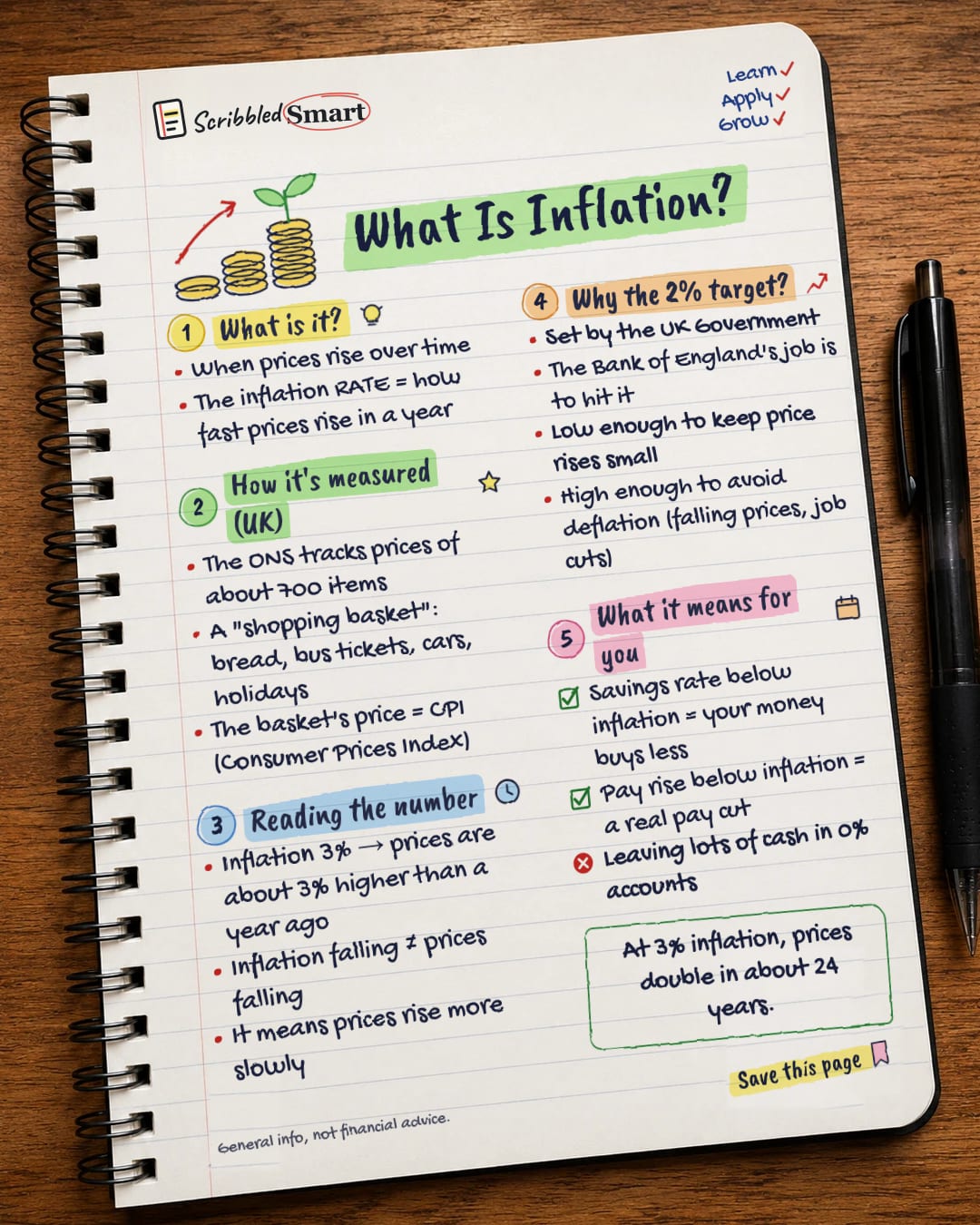
What is inflation? It's when prices rise over time. The inflation rate tells you how fast they're rising: if inflation is 3%, prices are about 3% higher than a year ago. This explainer covers how the UK measures inflation, why the Bank of England aims for 2%, and what it means for your savings and your pay.
What is inflation?
The Bank of England defines inflation as prices rising over time, and the inflation rate as how quickly they rise. A loaf of bread, a bus ticket and a holiday all tend to cost a bit more each year. Inflation is the average of that rise across everything people buy.
How inflation is measured in the UK
The "shopping basket"
The Office for National Statistics (ONS) measures inflation with an imaginary shopping basket. It collects around 180,000 prices for about 700 items every month. The basket covers everyday things like bread and bus tickets, and bigger items like cars and holidays (ONS; Bank of England).
CPI: the Consumer Prices Index
The total price of the basket is tracked as the Consumer Prices Index (CPI). The change in CPI compared with a year earlier is the inflation rate you hear on the news.
Other UK measures: CPIH and RPI
There are other measures too:
- CPIH includes housing costs. It's the ONS's lead measure.
- RPI is an older measure.
The Bank of England's target uses CPI.
How to read the inflation number
- Inflation 3% → prices are about 3% higher than a year ago (ONS).
- Inflation falling from 5% to 3% → prices are still rising, just more slowly.
That second point confuses many people. Lower inflation doesn't mean prices are falling. Prices only fall when inflation drops below zero.
The inflation figure changes every month, so we never quote "today's inflation" on this page. Check the latest figure on the ONS website.
Why is the UK inflation target 2%?
The UK Government sets the 2% target, and the Bank of England is responsible for meeting it. According to the Bank of England, 2% is:
- Low enough to keep price rises small and manageable.
- High enough to avoid deflation: prices falling, which can lead to lower incomes and unemployment.
How the Bank of England fights high inflation
The Bank's main tool is Bank Rate, the interest rate it sets. Raising it makes borrowing more expensive and saving more attractive. That cools spending, which slows price rises.
How fast do prices double?
You can use the Rule of 72 from our compound interest guide: 72 ÷ inflation rate = roughly the years for prices to double.
At 3% inflation, prices double in about 24 years (72 ÷ 3; the exact figure is 23.4 years). Something that costs £10 today would cost about £20 in 24 years if inflation stayed at 3%.
The Bank of England has an online inflation calculator that shows how prices have changed over time.
What inflation means for you
Your savings
If your savings rate is below inflation, your money buys less each year, even though the number in your account grows. That follows directly from the definition. Keep an emergency fund in easy-access savings, but don't leave large amounts sitting at 0% for years.
Your pay
If your pay rise is below inflation, it's a real pay cut. You have more pounds, but they buy less than before. Knowing this helps when you negotiate your salary.
Long-term money
Over decades, beating inflation matters a lot. That's one reason people invest long-term money, for example in index funds, while accepting that investments can fall as well as rise.
Tips and mistakes
- ✅ Compare your savings rate with inflation, not just with other accounts.
- ✅ Treat a pay rise below inflation as a real pay cut.
- ❌ Leaving lots of cash in 0% accounts for years.
- ❌ Thinking "inflation is falling" means prices are coming down.
FAQ
What is inflation in simple terms?
Inflation is the rise in prices over time. The inflation rate measures how fast prices are rising compared with a year ago. For example, 3% inflation means things cost about 3% more than they did 12 months earlier. In the UK, the ONS measures it using a basket of about 700 everyday items.
Why does the Bank of England target 2% inflation?
The UK Government sets the 2% target, and the Bank of England's job is to meet it. The Bank says 2% is low enough to keep price rises small, but high enough to avoid deflation. Falling prices can lead to lower incomes and job cuts.
If inflation falls, do prices go down?
No. Falling inflation means prices are rising more slowly, not that they're falling. If inflation drops from 5% to 3%, prices are still going up, just at a slower pace. Prices only fall overall if inflation goes below zero, which is called deflation.
What is the difference between CPI and CPIH?
Both are UK inflation measures from the ONS. CPIH includes housing costs, and the ONS uses it as its lead measure. CPI doesn't include them, and it's the measure the Bank of England's 2% target is based on. RPI is an older measure.
How does inflation affect my savings?
If your savings earn less interest than the rate of inflation, the money in your account buys less each year. The balance still grows, but its real value falls. That's why it's worth comparing savings rates with inflation.
Related reading
- Compound interest explained: the Rule of 72 works for prices too.
- Index funds explained: one way people try to beat inflation over decades.
- How to negotiate your salary: avoid a real pay cut.
- Emergency fund: cash you need to reach, even with inflation.
Sources
- Bank of England: What is inflation?
- Bank of England: Inflation and the 2% target
- ONS: What is inflation and how do we calculate it?
- Bank of England: How have prices changed over time?
How we checked this
Every fact in this article comes from the 4 sources listed above, checked against official or peer-reviewed sources where possible. AI tools help with drafting; a person checks every fact against the sources. How we research
- Published and checked
- Next check
- if the Bank of England's inflation target changes
General info, not financial advice.
Spotted a mistake? Tell us and we'll fix it and log it on the corrections page.


