
On this page
Interleaving means mixing different types of problem in one study session, instead of practising one type at a time. It usually feels harder and messier than doing a block of the same thing. But in some studies, people who mixed their practice did better on the real test later. Here is what two well-known studies found, why it may work, and how to use it without overdoing it.
What is interleaving?
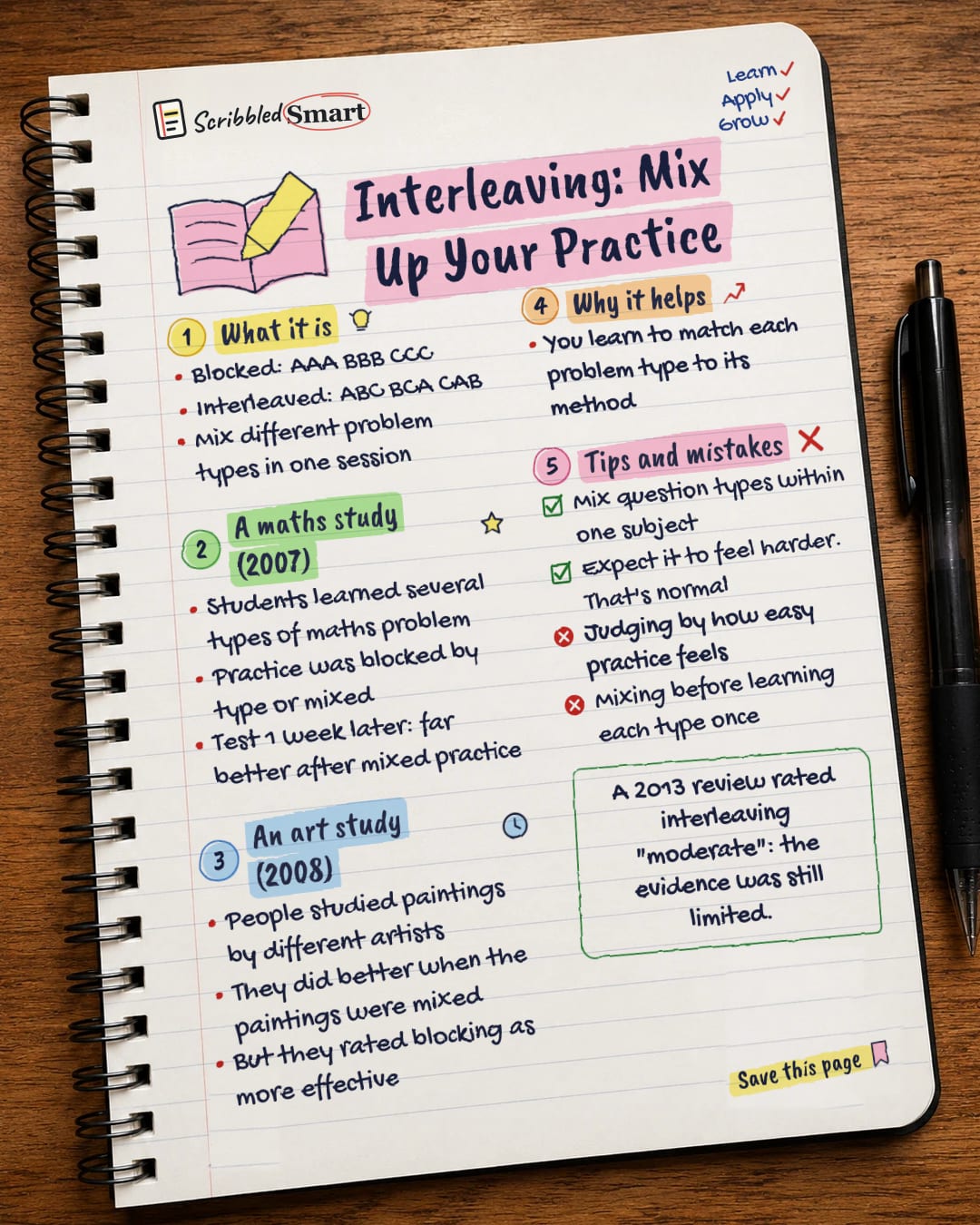
It is a way of ordering practice so that problem types are shuffled together. The letters below are just an illustration:
| Type of practice | Order of problems |
|---|---|
| Blocked | A A A, B B B, C C C |
| Interleaved | A B C, B C A, C A B |
In blocked practice, you do several problems of one kind before moving on. In interleaved practice, the types are mixed, so each problem could be any kind.
The maths study: shuffled problems (2007)
A well-known example comes from Rohrer and Taylor, published in Instructional Science in 2007. Students at the University of South Florida learned how to find the volume of four unusual geometric shapes.
One group practised in blocks, one shape at a time. The other group practised with the problem types mixed.
Practice scores vs test scores
| Blocked group | Mixed group | |
|---|---|---|
| Average during practice | 89% | 60% |
| Test 1 week later | 20% | 63% |
During practice, the blocked group looked far ahead. In the first session, they scored 87% against 43% for the mixed group. In the second session, it was 91% against 78%.
But on the test a week after the second practice session, the picture flipped. The mixed group scored 63%. The blocked group scored just 20%.
Why you should be careful with these numbers
This was a very small study. Only 18 students completed all the sessions, and 15 more dropped out. So the 63% against 20% result is striking, but it is not a general rule.
The art study: learning painters' styles (2008)
Interleaving isn't just for maths. In 2008, Kornell and Bjork published a study in Psychological Science in which people learned the painting styles of 12 artists, with six paintings by each.
Some paintings were shown in blocks by artist. Others were mixed in with other artists' work.
In the first experiment, with 120 participants:
- 78% did better when paintings were mixed.
- But 78% said blocking was as good as or better.
In other words, most people learned more from mixing, yet most also believed blocking worked as well or better.
Why does interleaving help?
The likely reason is that mixing forces you to choose. Rohrer and Taylor explained that mixed practice "requires that students learn to pair a type of problem with its appropriate procedure".
With blocked practice, you already know which method to use, because every problem in the block is the same type. With mixed practice, you have to work out which method fits. That is closer to what a real exam asks of you.
Researchers still debate the exact mechanism. Later work (Kang and Pashler, 2012) argued the benefit comes from the contrast between types, rather than from time gaps between them. So treat the explanation above as a simple guide, not the full story.
What did the 2013 review say about interleaving?
In 2013, Dunlosky and colleagues rated 10 study techniques. Interleaved practice was rated "moderate" utility: promising, but needing more research.
Tips for using interleaving
- Mix topics when doing past papers. Instead of 20 questions on one topic, shuffle questions from several.
- Expect it to feel harder. In both studies, mixed practice felt or looked worse during learning. That is normal.
- Learn each type first. In the maths study, students were taught all four shapes before they practised.
Interleaving pairs well with spacing your revision out over days.
Interleaving mistakes to watch for
- Judging by how easy practice feels. Smooth practice can hide weak learning, as the blocked group's 89% shows.
- Mixing before you understand each type. Mixing works best once you know the basics of each method.
Interleaving mostly helps when the problem types are similar enough to confuse. Evidence for mixing completely unrelated subjects is weaker, although one classroom study (Rohrer, Dedrick and Burgess, 2014) reportedly found a benefit even with dissimilar problem types. A sensible place to start is mixing topics within one subject, for example when working through past papers.
Related reading
- Spaced repetition: spreading study over days, which works well alongside interleaving.
- Active recall: mixed past-paper questions are also a form of self-testing.
- The multitasking myth: why mixing problem types in one session isn't the same as doing two things at once.
Sources
- Rohrer & Taylor (2007): The shuffling of mathematics problems improves learning (PDF)
- University of South Florida repository: Rohrer & Taylor (2007) record
- Psychology in Action: Desirable difficulties in math teaching
- Kornell & Bjork (2008): Learning Concepts and Categories (PDF, UCLA Bjork Lab)
- APS: Which study strategies make the grade?
How we checked this
Every fact in this article comes from the 5 sources listed above, checked against official or peer-reviewed sources where possible. AI tools help with drafting; a person checks every fact against the sources. How we research
- Published and checked
Spotted a mistake? Tell us and we'll fix it and log it on the corrections page.


