
On this page
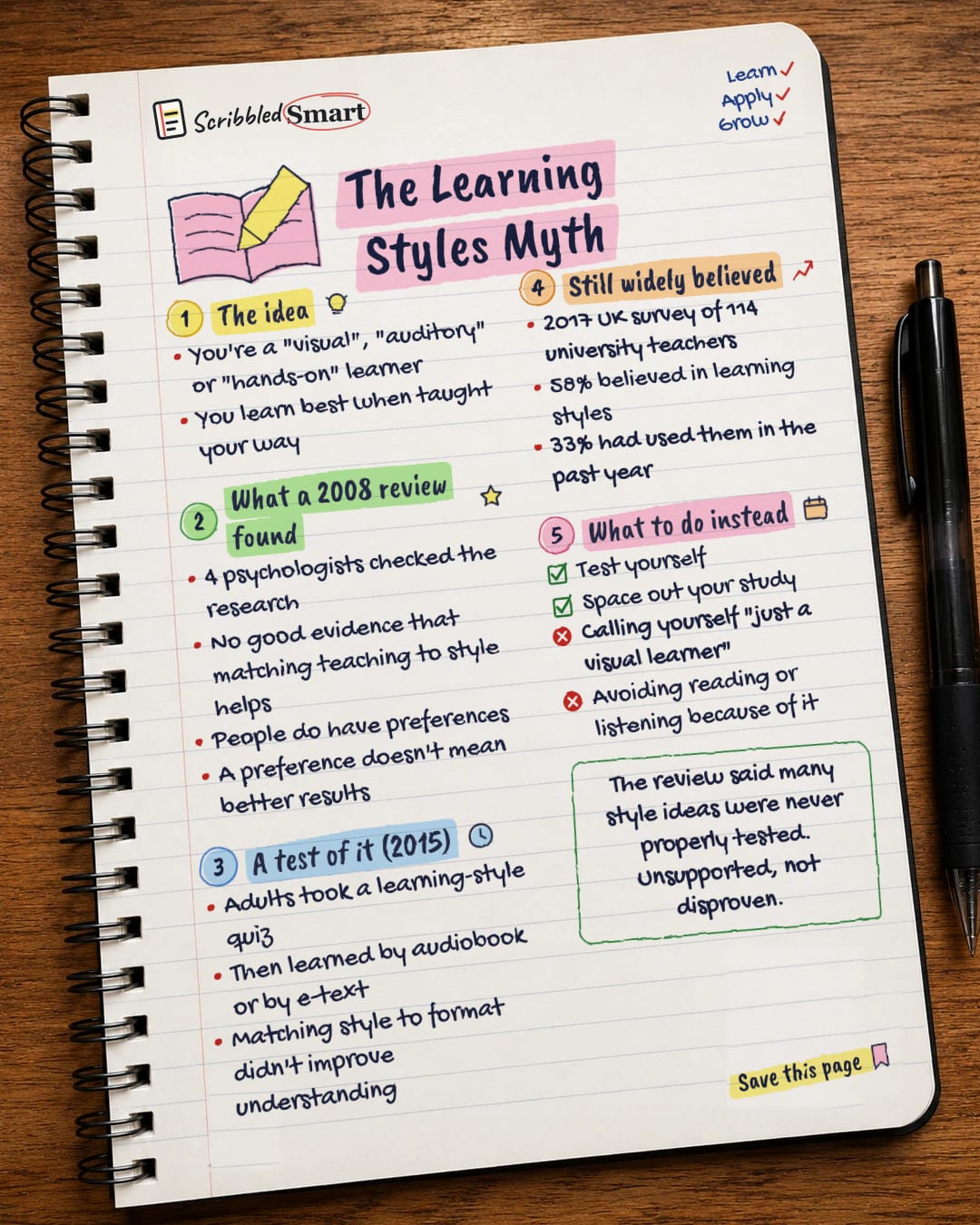
The idea that you learn best when teaching matches your "learning style" (visual, auditory or hands-on) is not supported by good evidence. A 2008 review by four psychologists found that matching teaching to style didn't reliably help, and later tests agreed. People do have preferences. They just don't seem to predict how well you learn. Here is what the research found and what to do instead.
What are learning styles?
Learning styles are labels for how people supposedly learn best. Common examples are:
- Visual: learning by seeing
- Auditory: learning by listening
- Kinaesthetic (hands-on): learning by doing
The central claim is that people "learn better when they receive information in their preferred Learning Style". Researchers sometimes call this the "meshing" idea: match the teaching to the learner, and results improve.
What the 2008 review found about learning styles
In 2008, Pashler, McDaniel, Rohrer and Bjork reviewed the evidence in Psychological Science in the Public Interest. Their conclusion was that the evidence does not justify using learning-styles tests in general education.
What a fair test would look like
The reviewers explained what proof would need. A valid study would show a "crossover" result:
- People with style A do better when taught with method A.
- People with style B do better when taught with method B.
Few studies used that design. Those that did mostly failed to find the crossover.
Preferences are real, but they're not the point
There is plenty of evidence that people say they prefer to learn in certain ways. What is missing is evidence that matching teaching to that preference actually improves learning.
The reviewers also did not say everyone learns the same. Differences such as prior knowledge do matter. The claim is narrower: matching teaching to a "style" isn't supported.
Testing learning styles directly (2015)
A 2015 study by Rogowsky, Calhoun and Tallal, in the Journal of Educational Psychology, put the idea to a direct test.
- Adults took a standard learning-style questionnaire.
- They then learned material either by audiobook (listening) or by e-text (reading).
- Their understanding was tested straight away and again two weeks later.
The result: there was no significant link between style and format. "Auditory" learners didn't understand more from the audiobook, and "visual" learners didn't understand more from the text.
A 2020 follow-up by Rogowsky and colleagues repeated the design with fifth graders. Again, there was no matching effect.
Why do people still believe in learning styles?
It is a popular and intuitive idea, and some educators still use it. In 2017, Newton and Miah surveyed 114 academics working in UK higher education:
| Survey finding | Share |
|---|---|
| Believed people learn better in their preferred style | 58% |
| Had used learning styles in the last 12 months | 33% |
| Agreed learning styles have a basic conceptual flaw | 90% |
Belief was lower than in earlier surveys. This was a convenience sample, not a representative one, so the percentages are a snapshot rather than a measure of all UK lecturers.
Unsupported, not disproven
The fairest summary is that learning styles are unsupported. The 2008 review noted that many style ideas have never been properly tested, so they can't be dismissed as proven false either. What we can say is that there is no good evidence for building your study around them.
What should you do instead of learning styles?
Focus on study methods with stronger evidence behind them:
- Test yourself. See our guide to active recall and why testing beats re-reading.
- Space out your study. Our guide to spaced repetition explains how.
Traps to avoid
- Calling yourself "just a visual learner". A label can stop you trying methods that would help.
- Avoiding reading or listening because of your "style". In the 2015 study, format didn't depend on style, so there's no reason to rule either out.
FAQ
Are learning styles real?
People really do have preferences for how they like to learn, but there's no good evidence that teaching to those preferences improves learning. A 2008 review found the evidence didn't justify using learning-styles tests in education, and a 2015 study found that matching style to format didn't improve understanding.
Am I a visual learner?
You may prefer pictures and diagrams, and that's fine. But research hasn't shown that people who call themselves visual learners actually learn more when taught visually. In a 2015 study, adults' learning-style results didn't predict whether they understood more from an audiobook or from reading text.
Why is the learning styles theory called a myth?
Because a popular belief has very little evidence behind it. A 2008 review set out what a fair test would need, a crossover result, and found that few studies used that design and those that did mostly failed. Yet in a small 2017 UK survey, 58% of academics still believed in learning styles.
Related reading
- Spaced repetition: one of the methods to use instead of style matching.
- Cognitive biases and thinking traps: why intuitive ideas can feel true without evidence.
- The Dunning–Kruger effect: another popular psychology idea that is often misunderstood.
Sources
- University of South Florida repository: Pashler et al. (2008), Learning Styles: Concepts and Evidence
- Frontiers in Psychology: Newton & Miah (2017), Evidence-Based Higher Education – Is the Learning Styles 'Myth' Important?
- Zenodo: Rogowsky, Calhoun & Tallal (2015), Matching learning style to instructional method
- Frontiers in Psychology: Rogowsky et al. (2020) follow-up
How we checked this
Every fact in this article comes from the 4 sources listed above, checked against official or peer-reviewed sources where possible. AI tools help with drafting; a person checks every fact against the sources. How we research
- Published and checked
Spotted a mistake? Tell us and we'll fix it and log it on the corrections page.


