
On this page
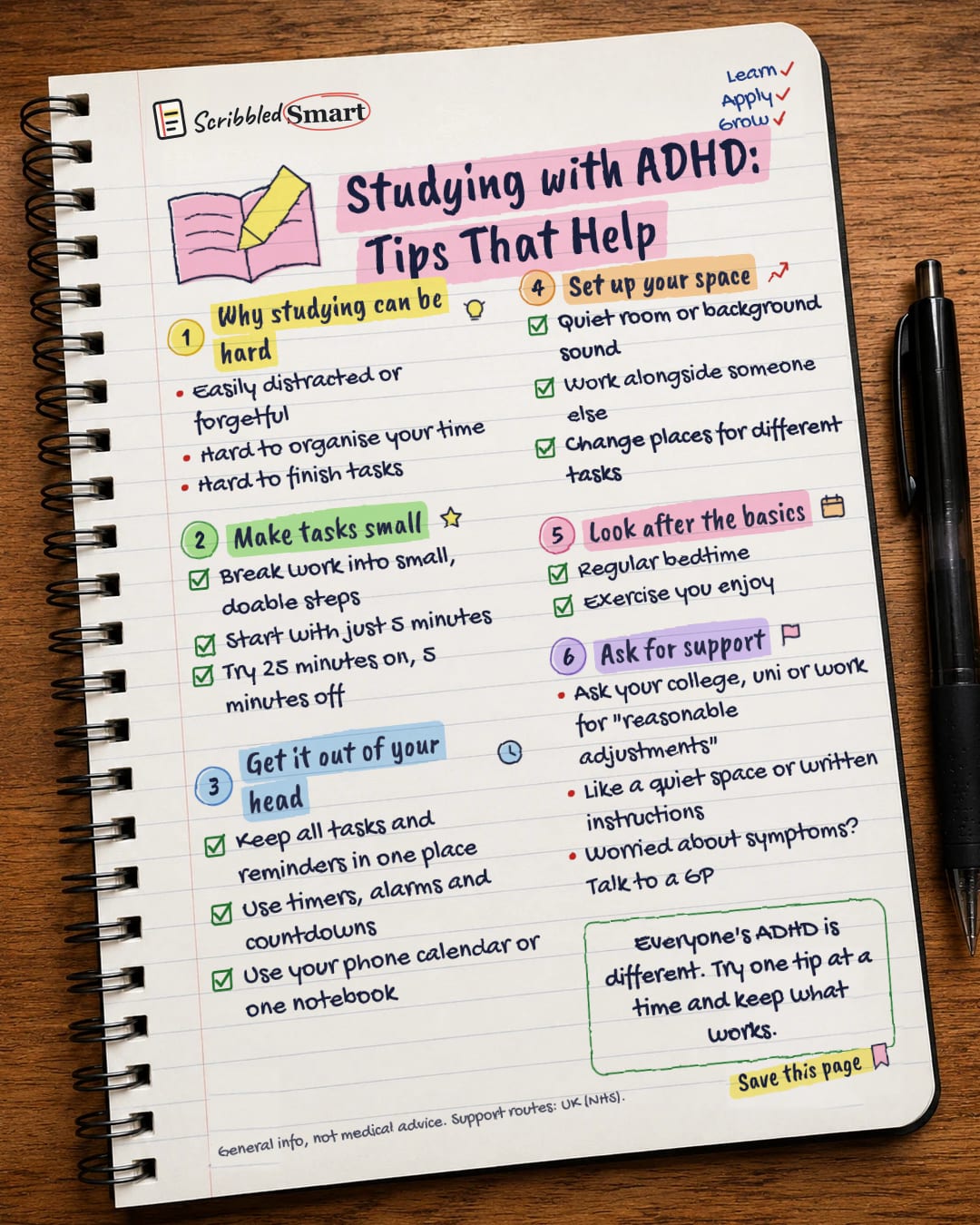
Studying with ADHD may get easier when you make tasks very small, get reminders out of your head and into one place, and set up your space so it's easier to start. These ideas come from NHS guidance and an NHS trust's ADHD support pages. They are practical strategies, not proven treatments, so try one at a time and keep what works for you.
Why can studying with ADHD be hard?
ADHD can affect attention and organisation, two skills that studying relies on. The NHS lists signs of inattention in adults that include:
- being easily distracted or forgetful
- finding it hard to organise your time
- finding it hard to follow instructions or finish tasks
The NHS also notes that hyperactivity tends to decrease in adults, while inattentiveness can get worse as adult life adds pressure.
Make study tasks small
Smaller tasks are easier to begin. Leicestershire Partnership NHS Trust suggests making tasks "smaller and more doable".
- Break work into small, doable steps. "Write essay" becomes "write three bullet points for the introduction".
- Start with just 5 minutes. The trust suggests you "start for just five minutes".
- Try 25 minutes on, 5 minutes off. The trust suggests working "for 25 minutes and then take a five-minute break". This is very similar to the Pomodoro technique for working in short bursts.
Get it out of your head
Your memory doesn't have to hold everything. The same NHS trust says that "keeping one central place for tasks and reminders can make things feel more manageable".
- Keep all tasks and reminders in one place, not spread across apps, sticky notes and scraps of paper.
- Use timers, alarms and countdowns. The trust says these "provide structure".
- Use your phone calendar or one notebook. The trust mentions "your phone calendar or a notebook you always carry".
Set up your study space
The right setting can make focus easier. The trust's suggestions include:
- A quiet room, or background sound. Some people focus better in silence, others with background sounds or music.
- Working alongside someone else. The trust says "working with another person can make it easier to get started". You may have seen this called "body doubling" online, though the NHS page doesn't use that term.
- Changing places for different tasks. The trust suggests you "try changing environments for different tasks".
Look after the basics
Sleep and exercise matter too. The NHS ADHD in adults page includes these among things you can try:
- A regular bedtime.
- Physical activity you enjoy.
For more on why sleep matters for learning, see our guide to sleep and memory, and why all-nighters backfire.
What support can you get for studying with ADHD?
You don't have to manage everything alone. Support is available at college, university and work.
Reasonable adjustments (UK)
🇬🇧 UK only. In the UK, colleges and employers can make "reasonable adjustments". This is a legal term from the Equality Act 2010. The NHS gives examples such as:
- a quiet personal workspace
- written as well as spoken instructions
- help planning tasks
Other countries have different rules, so check what applies where you live.
Disabled Students' Allowance (England)
🇬🇧 England only. If you live in England and are going to university, you may be able to apply for Disabled Students' Allowance (DSA). GOV.UK lists a "specific learning difficulty, such as dyslexia or ADHD" among the conditions that can qualify. DSA is based on your needs, not your household income, and you don't have to pay it back. You must also be eligible for full support from Student Finance England.
Talk to a GP
If your symptoms are affecting your studies, work or relationships, the NHS advises making an appointment with a GP (a family doctor).
Tips for using these ideas
Everyone's ADHD is different. Try one tip at a time, give it a fair go, and keep what works. Drop what doesn't.
We found no strong trial evidence for specific study tips in ADHD, so none of these are "proven". This page also doesn't cover medication, diagnosis, causes or diet. Speak to a GP or your care team about those.
FAQ
How can I focus on studying with ADHD?
Try starting very small. Leicestershire Partnership NHS Trust suggests breaking work into doable steps, starting for just five minutes, and trying 25 minutes of work followed by a five-minute break. Timers, alarms, a quiet room or background sound, and working alongside someone else can also make it easier to get going.
Can I get Disabled Students' Allowance for ADHD?
If you live in England, possibly. GOV.UK lists a specific learning difficulty such as ADHD among the conditions that can qualify for Disabled Students' Allowance. It is based on need rather than household income, and it does not need to be paid back. You must also be eligible for full Student Finance England support.
When should I see a GP about ADHD?
The NHS says to make a GP appointment if your symptoms are affecting your studies, work or relationships. Signs of inattention in adults include being easily distracted or forgetful, finding it hard to organise your time, and finding it hard to finish tasks.
Related reading
- Why we procrastinate: understanding why starting feels so hard.
- Why writing a plan calms your mind: more on getting tasks out of your head.
- Active recall for revision: a study method you can use in short sessions.
Sources
- NHS: ADHD in adults
- NHS: ADHD in children and young people, living with
- Leicestershire Partnership NHS Trust: ADHD strategies and support
- GOV.UK: Disabled Students' Allowance (DSA)
- GOV.UK: Disabled Students' Allowance, eligibility
How we checked this
Every fact in this article comes from the 5 sources listed above, checked against official or peer-reviewed sources where possible. AI tools help with drafting; a person checks every fact against the sources. How we research
- Published and checked
- Next check
- yearly (NHS pages; NHS ADHD in adults page next review due 19 March 2028)
General info, not medical or legal advice. Support routes: UK (NHS).
Spotted a mistake? Tell us and we'll fix it and log it on the corrections page.


