
On this page
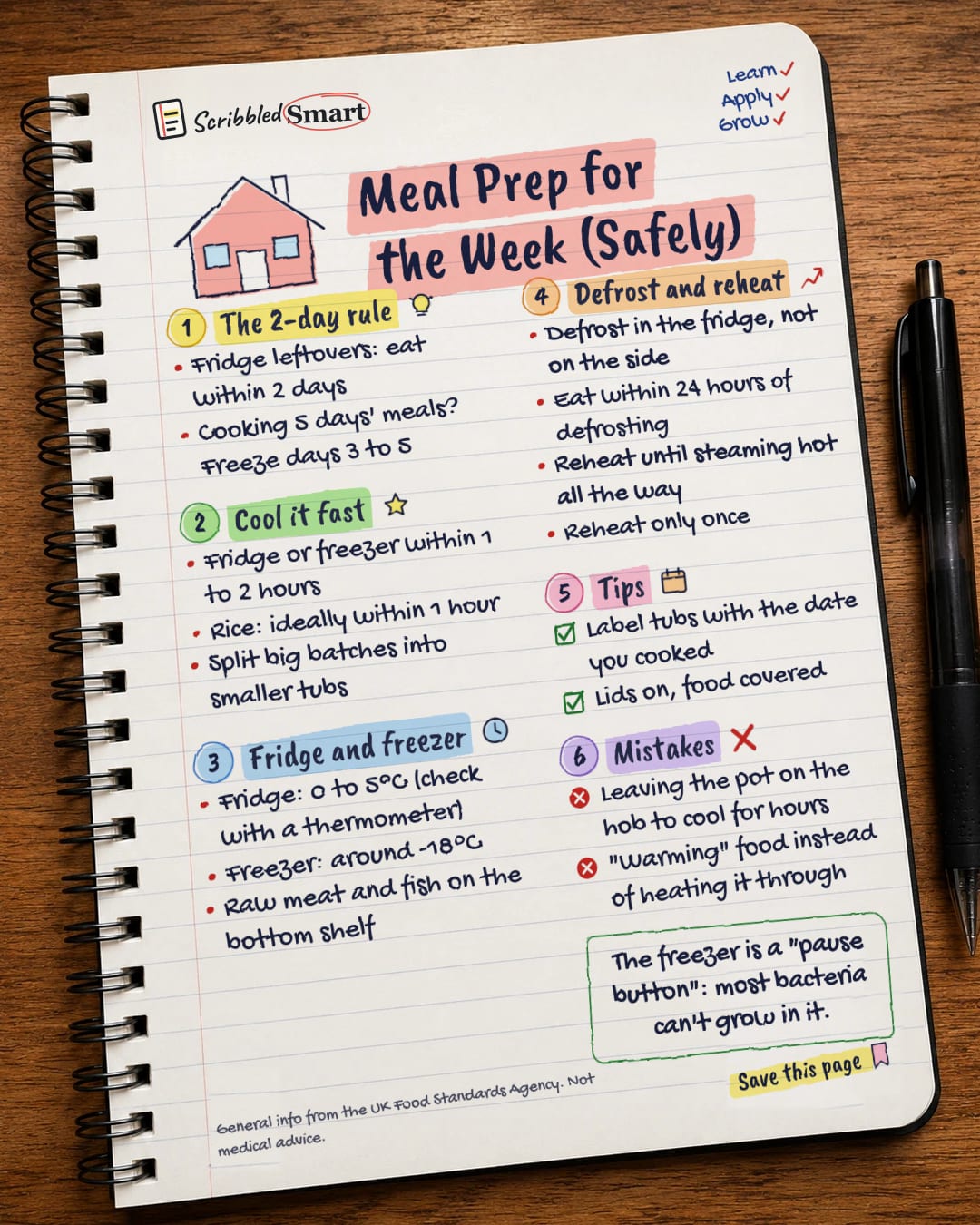
You can meal prep for a week safely if you follow one simple rule from the UK Food Standards Agency (FSA): eat fridge leftovers within 2 days, and freeze the rest. So if you cook five days' worth of meals on Sunday, keep days 1 and 2 in the fridge and freeze days 3 to 5. This guide covers cooling, storing, defrosting and reheating, step by step.
The 2-day rule for meal prep
Leftovers in the fridge should be eaten within 2 days. The FSA says eat leftovers within 48 hours or freeze them. Its student guide puts it another way: if you cook more portions than you can eat in two days, freeze the extra portions.
Here is how that works for a typical week of prepped meals:
| Meal | Where it goes after cooking |
|---|---|
| Day 1 | Fridge |
| Day 2 | Fridge |
| Day 3 | Freezer |
| Day 4 | Freezer |
| Day 5 | Freezer |
Each evening, you can move the next frozen portion into the fridge to defrost.
Cool it fast
Cooked food needs to be cooled and chilled quickly. The FSA says put leftovers in a fridge or freezer within one to two hours.
Rice is stricter
Rice has its own rule. The FSA says to chill cooked rice ideally within one hour. Our guide to keeping cooked rice safe explains why.
Split big batches
Splitting a big batch into smaller tubs helps it cool. The FSA and Food Standards Scotland say smaller portions cool faster (they say this about rice, and the same idea helps with other big batches).
Why speed matters
The FSA student guide says the "danger zone", where bacteria grow, is between 8 and 63°C. It also says not to leave food in the pan for long periods, as bacteria may grow.
What temperature should your fridge and freezer be?
Your fridge and freezer need to be at the right temperature to keep food safe.
| Appliance | FSA guidance |
|---|---|
| Fridge | Between 0 and 5°C. A fridge thermometer is the best way to check. |
| Freezer | Around -18°C |
Where to put things
Store raw meat, fish and shellfish on the bottom shelf of your fridge. Keep your cooked meal prep tubs above them, with lids on and food covered.
The freezer is a "pause button"
The FSA student guide says a freezer acts as a pause button: food in a freezer won't deteriorate, and most bacteria cannot grow in it. Note the word "most". Freezing doesn't kill bacteria. They can become active again once the food defrosts, which is why the defrosting rules below matter.
How do you defrost and reheat meal prep safely?
When it is time to eat a frozen meal, defrost it slowly and reheat it properly.
- Defrost in the fridge, not on the kitchen side. The FSA says don't defrost food at room temperature.
- Eat it within 24 hours of defrosting.
- Reheat until steaming hot all the way through, not just warmed.
- Reheat only once. The FSA says you should only ever reheat leftovers once.
Can you refreeze it?
The FSA says food cooked from frozen can be frozen again once it is cooked. After that, reheat it only once.
Meal prep for a week: tips that help
A few small habits make batch cooking safer and easier.
- ✓ Label tubs with the date you cooked. Then you know which ones to eat first.
- ✓ Lids on, food covered. The FSA says cool and cover your leftovers.
- ✓ Freeze shop-bought food in time. The FSA says you can freeze pre-packed food right up to its use-by date. Our guide to use-by vs best before dates explains the difference.
- ✓ Don't wash raw chicken. The FSA student guide says splashing spreads campylobacter bacteria.
Common meal prep mistakes
Watch out for these four habits.
- ✗ Leaving the pot on the hob to cool for hours. Bacteria may grow in food left in the pan.
- ✗ "Warming" food instead of heating it through. It needs to be steaming hot throughout.
- ✗ Keeping five days of meals in the fridge. Stick to 2 days in the fridge and freeze the rest.
- ✗ Defrosting on the side. Use the fridge instead.
FAQ
How long does meal prep last in the fridge?
The FSA says eat leftovers within 48 hours, or 2 days, or freeze them. If you cook more portions than you can eat in two days, freeze the extra portions. For a five-day plan, that means keeping days 1 and 2 in the fridge and freezing days 3 to 5.
Can you meal prep for 5 days?
Yes, as long as you use the freezer. The FSA's 2-day rule means fridge leftovers should be eaten within 2 days. So cook all five meals, keep two in the fridge and freeze the other three. Defrost each one in the fridge, then eat it within 24 hours.
How quickly should you put leftovers in the fridge?
The FSA says put leftovers in the fridge or freezer within one to two hours of cooking. Rice is stricter: ideally within one hour. Split big batches into smaller tubs so they cool faster, and don't leave food sitting in the pan for long periods, because bacteria may grow.
Can you reheat meal prep more than once?
No. The FSA says you should only ever reheat leftovers once. Reheat until the food is steaming hot all the way through, rather than just warmed. If you prep in big batches, portion them into separate tubs first so you only reheat the meal you are about to eat.
Related reading
- Protein basics: how much protein to build into your weekly meals.
- Five a day: what counts when you plan your fruit and veg.
Sources
- FSA (GOV.UK): How to chill, freeze and defrost food safely
- FSA (GOV.UK): Student guide to food safety and hygiene
- FSA (GOV.UK): Home food fact checker
- GOV.UK: Understanding food labelling, best before and use-by dates
How we checked this
Every fact in this article comes from the 4 sources listed above, checked against official or peer-reviewed sources where possible. AI tools help with drafting; a person checks every fact against the sources. How we research
- Published and checked
General info, not medical advice. Based on UK Food Standards Agency guidance.
Spotted a mistake? Tell us and we'll fix it and log it on the corrections page.


