
On this page
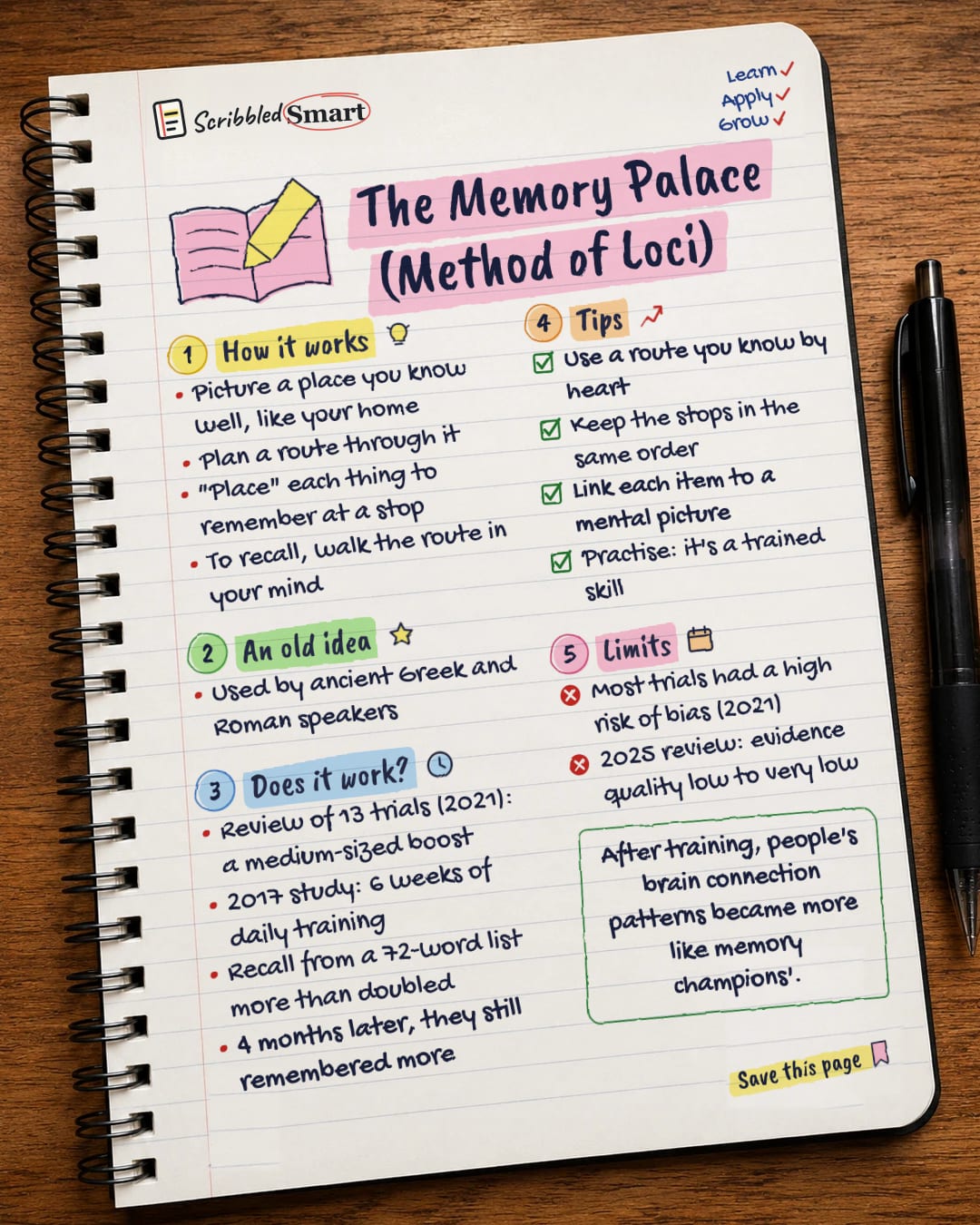
A memory palace is a way of remembering a list by picturing a place you know well, then "placing" each item at a stop along a route through it. To recall the list, you walk the route in your mind and collect each item. Its proper name is the method of loci. Studies suggest it helps with memorising lists, especially with practice, but the evidence has limits.
How do you build a memory palace?
You need a place you know by heart and a fixed route through it. The method has four steps:
- Picture a place you know well, such as your home.
- Plan a route through it, with clear stops: the front door, the hall, the kitchen table, and so on.
- "Place" each item at a stop. Make a mental picture that links the item with that landmark.
- To recall, walk the route in your mind and see what is waiting at each stop.
Stanford Medicine describes it as linking each item with "a mental picture of a specific landmark along a familiar route".
Is the method of loci an old idea?
Yes, very old. Ancient Greek and Roman speakers (orators) used it.
You may have heard a dramatic origin story about a collapsed banquet hall. That story is a legend, so we leave it there.
Does the memory palace work?
The research says yes, for lists, with some caveats.
A review of 13 trials
In 2021, Twomey and Kroneisen published a meta-analysis of 13 randomised controlled trials in the Quarterly Journal of Experimental Psychology. They found a medium-sized effect (g = 0.65). They also flagged a high risk of bias in most of the studies they included.
A 2025 review (Ondřej, British Journal of Psychology) found an even bigger effect, but rated the quality of the evidence as low to very low. So the method looks helpful, but the studies behind it are not as strong as we'd like.
The 2017 training study
A well-known study is by Dresler and colleagues, published in Neuron in 2017. They compared 23 memory athletes, drawn from the top 50 in the World Memory Championships, with 23 matched people who were not.
Then 51 new volunteers were split into three groups: memory palace training, a different working-memory training, or no training. The memory palace group trained for 40 daily sessions of 30 minutes, about six weeks.
The results:
- Recall from a 72-word list more than doubled in the memory palace group. Reports give slightly different exact numbers, so "more than doubled" is the safest summary.
- Four months later, only the memory palace group still remembered more than before training.
- For comparison, the memory athletes recalled nearly 71 of the 72 words.
What changed in the brain
After training, people's patterns of brain connections became more like those of the memory athletes. This was still the case four months later.
Tips for using a memory palace
- Use a route you know by heart. The method depends on a familiar place.
- Keep the stops in the same order every time.
- Make each picture odd and vivid. This is common advice for memory techniques, though the studies here didn't test it directly.
- Practise. It is a trained skill. In the 2017 study, people trained for six weeks, and the untrained groups gained far less.
Limits of the memory palace
- Mostly tested on lists, not understanding. Most studies use word lists and recall in order. It is not proven to help you understand a topic.
- Won't work well without practice. A quick first try won't match the results above.
The memory palace was not one of the 10 methods rated in a well-known 2013 review of study techniques. That review did rate two other imagery-based methods (the keyword mnemonic and imagery for text) as low utility for typical school learning. So for understanding a topic, rather than memorising a list, look at other methods too, such as active recall, where you test yourself from memory.
FAQ
How long does it take to learn the memory palace technique?
In a 2017 study, volunteers trained for 40 daily sessions of 30 minutes, or about six weeks. By the end, their recall from a 72-word list had more than doubled. The method is a trained skill, so expect it to take steady practice rather than work fully on the first go.
Can a memory palace help with exams?
It may help with exam material that is list-like, such as sequences or sets of facts. Most research tests word lists and recall in order, not understanding. The method was also not among the 10 techniques rated in a major 2013 review of study methods, so pair it with other ways of revising.
Do memory champions use the memory palace?
Memory athletes were the comparison group in a 2017 study of the method. After six weeks of memory palace training, ordinary volunteers' brain connection patterns became more like those of the athletes. The athletes themselves recalled nearly 71 of 72 words on the same kind of list test.
Related reading
- Spaced repetition for long-term memory: how to keep what you memorise by reviewing it over time.
- The learning styles myth: another popular memory and learning idea, checked against the research.
- Why highlighting and re-reading don't work well: the 2013 review's verdict on the most common study habits.
Sources
- ScienceDaily (2017): Memory athletes' brain training
- Stanford Medicine (2017): Memorization tool bulks up brain's internal connections
- PMC: Dresler et al. (2017), Mnemonic Training Reshapes Brain Networks to Support Superior Memory
- Twomey & Kroneisen (2021): The effectiveness of the loci method as a mnemonic device (record)
- PMC: Ondřej (2025), review of the method of loci
How we checked this
Every fact in this article comes from the 5 sources listed above, checked against official or peer-reviewed sources where possible. AI tools help with drafting; a person checks every fact against the sources. How we research
- Published and checked
Spotted a mistake? Tell us and we'll fix it and log it on the corrections page.


