
On this page
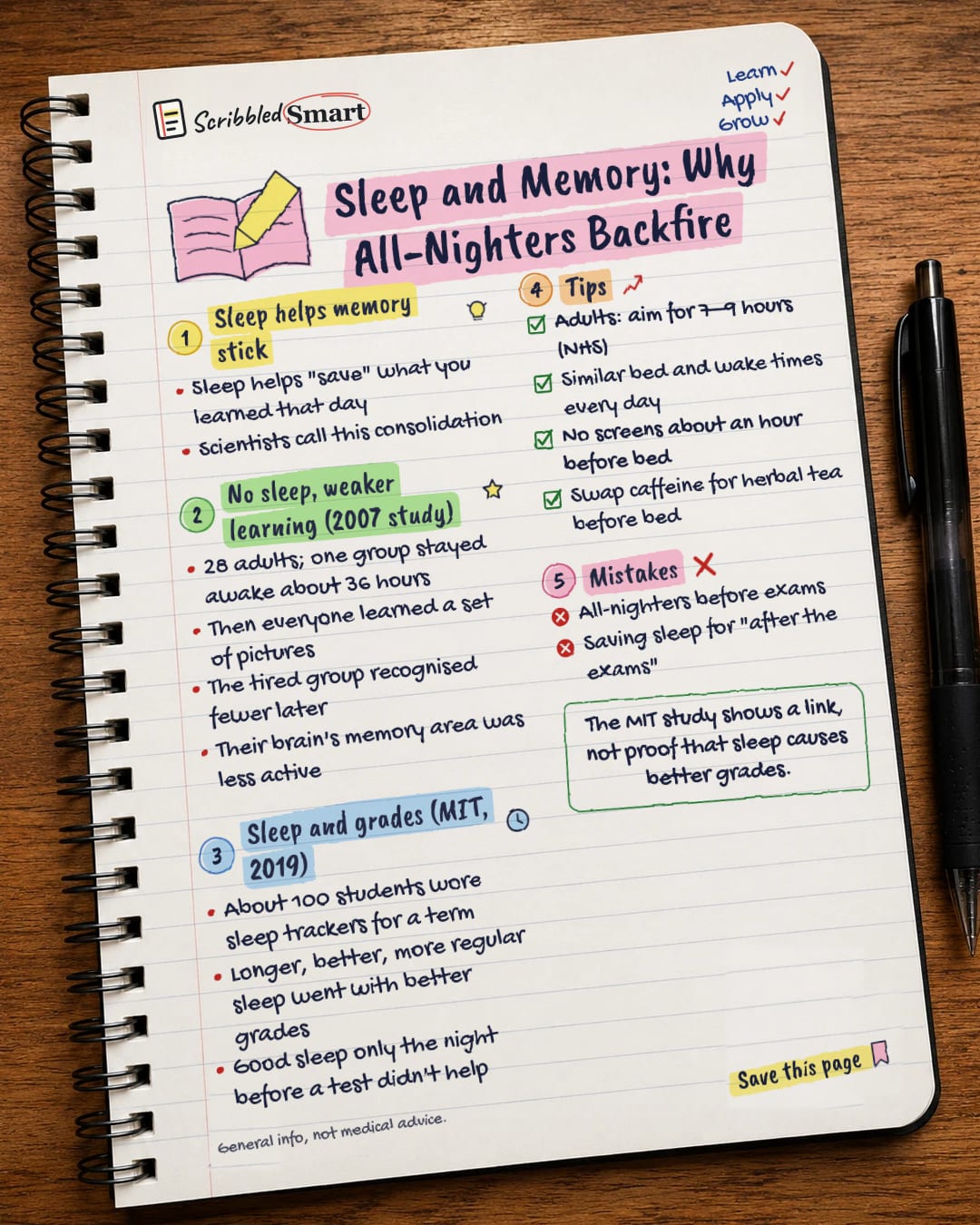
Sleep and memory are tightly connected: sleep helps your brain "save" what you learned during the day, and missing sleep makes it harder to learn new things. That is why pulling an all-nighter before an exam tends to work against you. Below, we look at two well-known studies, what they can and can't prove, and simple NHS sleep tips.
How does sleep help memory?
Sleep strengthens memories you formed while awake. A 2010 review by Diekelmann and Born, in Nature Reviews Neuroscience, describes sleep as optimising the consolidation of newly learned information. So sleep helps the day's learning stick.
Some research suggests different stages of sleep may help with different kinds of memory. Early, deep (slow-wave) sleep may favour facts, while REM sleep may favour skills. The exact mechanisms are still debated, so treat this as a working idea rather than settled science.
Sleep and memory: what happens when you skip a night
You become worse at taking in new information. A 2007 study by Yoo, Walker and colleagues, published in Nature Neuroscience, tested this with 28 adults.
- One group stayed awake for about 36 hours. The other slept normally.
- Then everyone learned a set of pictures.
- After two normal nights of sleep, they were tested on which pictures they recognised.
The sleep-deprived group recognised fewer pictures. Brain scans also showed less activity in the hippocampus, the brain's memory area, while they were learning.
Reports give different figures for how big the drop was, because they used different measures. So we don't quote a single number. It is also worth keeping in mind that this was a small lab study using pictures, not exam results.
Does sleep affect your grades?
It seems to. In 2019, researchers at MIT (Okano, Kaczmarzyk, Dave, Gabrieli and Grossman) gave Fitbit sleep trackers to 100 students for a whole term.
What they found
- Students who slept longer, better and more regularly tended to get better grades.
- Good sleep only on the night before a big test did not help. As the MIT report put it, "it takes several nights in a row".
- Going to bed after about 2am went with lower scores, even when total sleep was the same.
A link, not proof
This study shows a connection, not that sleep caused better grades. The researchers themselves said the link can't absolutely prove sleep was the factor. Robert Stickgold, who was quoted in the MIT report but was not an author of the study, said "correlation is not the same as causation".
How much sleep do you need?
For adults, the NHS (the UK's health service) says: "Most healthy adults need around 7 to 9 hours of sleep a night, although the exact amount can be different for each person."
Advice for teenagers varies between sources, so we haven't given a figure here. Check NHS guidance directly if you are under 18.
NHS tips for better sleep before exams
These come from the NHS Every Mind Matters guide to sleeping better:
- Keep similar bed and wake times every day.
- Avoid screens for about an hour before bed.
- Watch the caffeine. Tea, coffee and some soft drinks contain caffeine, which can keep you alert. Choose other drinks in the evening.
- Keep your bedroom quiet and dark.
- Avoid alcohol and nicotine in the 1–2 hours before bed.
Common sleep mistakes during exam season
- All-nighters before exams. The 2007 study suggests sleep loss makes new learning harder.
- Saving sleep for "after the exams". The MIT study found consistent sleep over many nights mattered, not one catch-up night.
Revising earlier and in shorter sessions makes it easier to protect your sleep. Our guide to spacing out your revision shows how.
FAQ
Is it better to sleep or study all night before an exam?
The research points towards sleeping. In a 2007 study, people kept awake for about 36 hours learned new pictures less well than people who slept, and their brain's memory area was less active. An MIT study also found that steady sleep over many nights went with better grades.
Does one good night's sleep before an exam help?
On its own, probably not much. An MIT study of 100 students found that good sleep only on the night before a big test didn't improve results. What mattered was longer, better and more regular sleep across the term. In the report's words, "it takes several nights in a row".
Does sleep really cause better grades?
Not proven. The MIT study found that better sleep habits were linked with better grades, but it was a correlation. The researchers said it can't absolutely prove that sleep was the cause. Separate lab research, such as the small 2007 sleep-loss study, suggests that missing sleep weakens new learning.
Related reading
- Sleep better with the NHS basics: more detail on building a healthy sleep routine.
- Studying with ADHD: includes NHS advice on a regular bedtime.
- How stress affects your body: exam stress and sleep often go together.
- Taking micro-breaks while you study: small rests during the day.
Sources
- NHS Every Mind Matters: Sleep problems
- NHS Every Mind Matters: How to fall asleep faster and sleep better
- BPS Research Digest: Students, it's time to ditch the pre-exam all-nighter
- MIT McGovern Institute: Better sleep habits lead to better college grades (2019)
- PubMed: Yoo et al. (2007), A deficit in the ability to form new human memories without sleep
- University of Lübeck: Diekelmann & Born (2010), The memory function of sleep
How we checked this
Every fact in this article comes from the 6 sources listed above, checked against official or peer-reviewed sources where possible. AI tools help with drafting; a person checks every fact against the sources. How we research
- Published and checked
- Next check
- yearly (NHS page)
General info, not medical advice.
Spotted a mistake? Tell us and we'll fix it and log it on the corrections page.


