
On this page
Weak ties, the people you know only a little, are often more useful for finding a new job than your closest friends, because they bring you information you don't already have. The idea goes back to a 1973 paper by sociologist Mark Granovetter. In 2022, a huge study using LinkedIn data tested it properly and found it largely holds up, with one twist: the very weakest connections help less. Here's what the research says and how to use it.
What is the strength of weak ties theory?
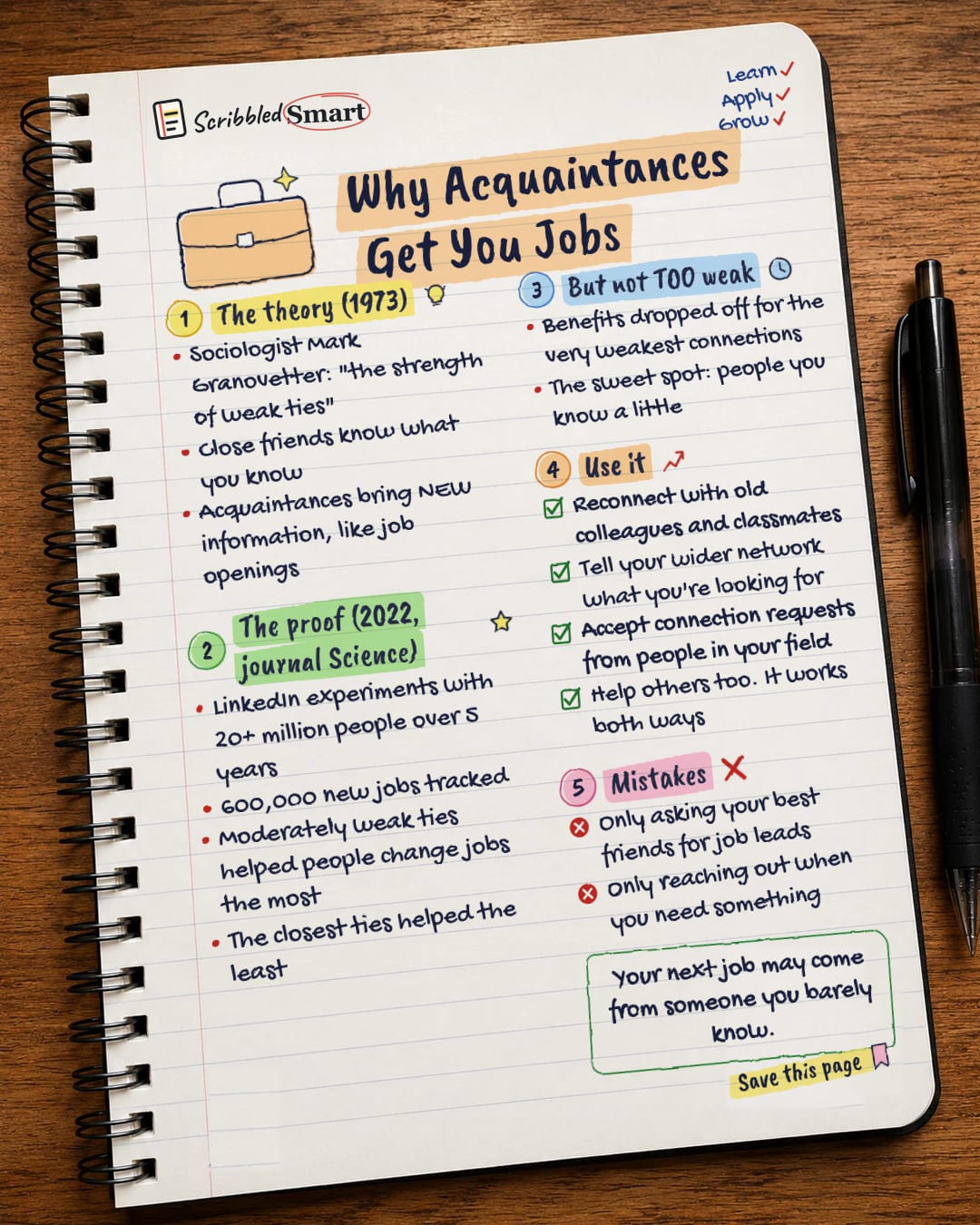
The theory says that acquaintances are valuable because they move in different circles from you. Mark Granovetter set it out in 1973 in a paper called "The Strength of Weak Ties", published in the American Journal of Sociology.
The reasoning is simple. Your close friends tend to know the same people and hear the same news as you. So for news like a job opening you haven't heard about, they often can't tell you much that's new. Acquaintances are more likely to know about things outside your bubble.
Do weak ties really help you get a job?
A 2022 LinkedIn study suggests they do. The theory was tested at huge scale that year. The study, "A causal test of the strength of weak ties", was published in the journal Science on 16 September 2022. Its authors were Rajkumar, Saint-Jacques, Bojinov, Brynjolfsson and Aral.
How big was the study?
| What | Number |
|---|---|
| People | More than 20 million |
| Time | 5 years |
| New connections formed | 2 billion |
| New jobs tracked | 600,000 |
Why it counts as a "causal" test
Simply watching people can only show that weak ties and job moves tend to go together. This study went further: it used experiments with LinkedIn's "People You May Know" feature, which suggests new connections. Running experiments let the researchers test cause and effect, not just a link between the two.
The main results
- Moderately weak ties had the biggest effect on people changing jobs.
- The strongest ties had the least effect.
- The very weakest ties helped less too. The researchers described the pattern as an "inverted U": benefits rise as ties get weaker, then fall off for the weakest connections of all.
So the sweet spot isn't strangers. It's people you know a little: a former colleague, someone from your course, a person you met at an event and still chat to now and then.
Important limits of the research
There are two caveats worth knowing.
It depends on your industry. The weak-tie advantage was stronger in more digital industries. In less digital industries, strong ties helped more. So if you work in a field that runs less on online tools, your close contacts may matter more than this study suggests.
The study raised ethics questions. LinkedIn ran the experiments on its users without asking for their explicit consent, which drew criticism in the press at the time (for example from The Register). That doesn't change the findings, but it's part of the story.
How to use weak ties in your job search
You don't need to become a networking expert. Small, genuine steps work:
- ✓ Reconnect with old colleagues and classmates. A short "Hope you're well, I saw your new role" message is enough to restart contact.
- ✓ Tell your wider network what you're looking for. People can't pass on openings if they don't know you're interested. A tidy LinkedIn profile with the right headline and skills helps here.
- ✓ Accept connection requests from people in your field, even if you've only met briefly.
- ✓ Help others too. Share openings you spot, and make introductions. It works both ways.
Mistakes to avoid
- ✗ Only asking your best friends for job leads. They care, but they often hear the same news you do.
- ✗ Only reaching out when you need something. Keep in light contact, so a message from you doesn't come out of nowhere.
Your next job may come from someone you barely know.
FAQ
What are weak ties?
Weak ties are people you know only a little, such as acquaintances, former colleagues or old classmates, rather than close friends and family. Mark Granovetter's 1973 theory argued that these looser connections are valuable because they pass on new information you wouldn't otherwise hear about, such as job openings.
Who did the 2022 LinkedIn weak ties study?
The study was carried out by Rajkumar, Saint-Jacques, Bojinov, Brynjolfsson and Aral, and published in the journal Science on 16 September 2022. It used experiments with LinkedIn's "People You May Know" feature, tracking 2 billion new connections and 600,000 new jobs over five years.
Are close friends useless for finding work?
No. In the 2022 study, strong ties helped more than weak ties in less digital industries. Close friends still matter. The research simply suggests that, for hearing about new opportunities, moderately weak ties tended to matter more overall.
Related reading
- LinkedIn profile checklist: make sure your wider network can see what you do.
- Introvert vs extrovert: what's true: if networking feels draining, start here.
- Email phrases that sound professional: easy wording for reconnecting with old contacts.
- How to spot a job scam: not every message from a "contact" is genuine.
Sources
- Science News: Lean more on weak ties
- MIT IDE: Weaker ties are more beneficial for job seekers on LinkedIn
- EurekAlert: News release on the 2022 weak ties study
- Rajkumar et al. (2022): A causal test of the strength of weak ties (PDF)
- The Register (2022): LinkedIn suggests acquaintances are better for job hunters
How we checked this
Every fact in this article comes from the 5 sources listed above, checked against official or peer-reviewed sources where possible. AI tools help with drafting; a person checks every fact against the sources. How we research
- Published and checked
Spotted a mistake? Tell us and we'll fix it and log it on the corrections page.


