
On this page
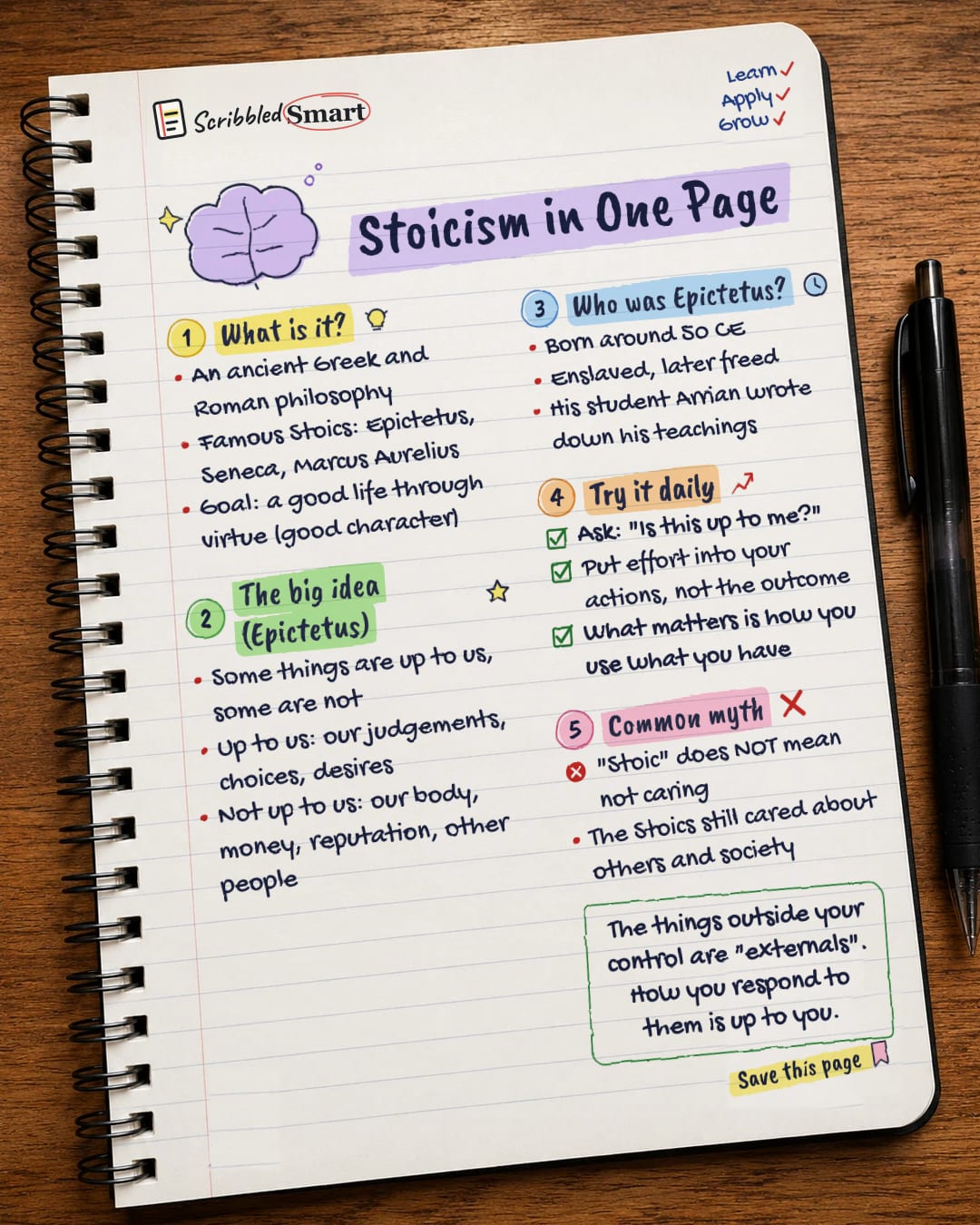
Stoicism is an ancient Greek and Roman philosophy that aims for a good life through virtue, meaning good character. Its most famous idea comes from the teacher Epictetus: some things are up to us, and some are not. This article explains where Stoicism came from, what that big idea means, and how to try it in everyday life.
Where did Stoicism come from?
Stoicism was founded in Athens around 300 BCE by Zeno of Citium. The name comes from the stoa poikilē, a porch in the Agora of Athens that was decorated with wall paintings. The first Stoics met and taught there.
The school later became important in Rome. Its three most famous names today are:
- Epictetus, a teacher whose ideas we look at below.
- Seneca, known for his "Letters to Lucilius".
- Marcus Aurelius, Roman Emperor from 161 to 180 CE, who was influenced by Epictetus. His "Meditations" was a private journal, not written for publication.
What the Stoics were aiming for
The Stoic goal is a good life through virtue. The Stanford Encyclopedia of Philosophy explains that for Epictetus, the good lies in a certain state of our own will, which is virtue.
The big idea: what is up to us
Stoicism's central idea is that some things are up to us and some are not. Epictetus' handbook, the Enchiridion, opens with exactly this point in its first chapter: "Some things are within our power, while others are not."
The Greek phrase Epictetus uses is eph' hēmin, meaning "up to us". You may also see this called the "dichotomy of control". That is a modern label, popularised by William Irvine, rather than Epictetus' own words.
| Up to us | Not up to us |
|---|---|
| Our judgements (opinions) | Our body |
| Our choices (Epictetus' word is prohairesis) | Our possessions and money |
| Our desires and aversions | Our reputation |
| Other people and our relationships |
"Externals"
Epictetus called the things outside our control "externals". The Stoic point is not that externals don't exist or never matter in daily life. It is that how you respond to them is up to you.
How you use what you have
Epictetus put it this way, as quoted in the Stanford Encyclopedia: "The materials of action are indifferent, but the use we make of them is not indifferent." Your situation is the raw material. What counts is what you do with it.
Who was Epictetus?
Epictetus was born in the 50s CE in Hierapolis and died around 135 CE. He was enslaved to Epaphroditus at the court of the emperor Nero, and was later freed.
He did not write his teachings down himself. His student, Arrian of Nicomedia, recorded them in the Discourses. The Enchiridion ("handbook") is a shorter version of that work, and a good place to start reading. Older public-domain translations of Epictetus include those by Elizabeth Carter (1758), Thomas Wentworth Higginson (1865) and George Long (1877), so you can read them for free.
How to use Stoicism day to day
You can practise Stoicism by sorting each worry into "up to me" or "not up to me", then putting your effort into the first group.
Ask: "Is this up to me?"
When something bothers you, ask the question. If it's a judgement, choice or desire, you can work on it. If it's an external, such as what someone else thinks of you, you can choose how you respond. This can be a useful step if you tend to go over the same worries again and again.
Put effort into your actions, not the outcome
You control how well you prepare for an interview or an exam. You don't control the final decision. Stoicism suggests judging yourself by the first, not the second.
Remember that how you use what you have is what matters
You might not choose your circumstances. Epictetus' point is that the use you make of them is still yours.
Does being Stoic mean you don't care?
Stoicism does not mean not caring. Focusing on what's up to you isn't the same as not caring about anything else.
It helps to separate two meanings of the word:
- small-s "stoic": keeping a stiff upper lip and not showing feelings.
- Capital-S "Stoic": the ancient philosophy described here.
As Philosophy Break points out, focusing on what's up to us doesn't excuse us from caring about wider problems in society. The idea is to put your energy where it can make a difference.
Common mistakes with Stoic ideas
- Thinking Stoic means emotionless. That is the everyday word "stoic", not the philosophy.
- Using "not up to me" as an excuse to do nothing. Your choices and actions are still up to you.
- Quoting the "dichotomy of control" as Epictetus' words. It's a modern label for his idea.
Related reading
- Stress and your body: what happens when worries about externals pile up.
- Cognitive biases: how our judgements, the part that is up to us, can go wrong.
- Imposter syndrome explained: a common worry about reputation, something Epictetus saw as an external.
Sources
- Stanford Encyclopedia of Philosophy: Epictetus
- Stanford Encyclopedia of Philosophy: Stoicism
- Dickinson College Commentaries: What is and is not in our control
- Philosophy Break: Dichotomy of control
How we checked this
Every fact in this article comes from the 4 sources listed above, checked against official or peer-reviewed sources where possible. AI tools help with drafting; a person checks every fact against the sources. How we research
- Published and checked
General info, not professional advice.
Spotted a mistake? Tell us and we'll fix it and log it on the corrections page.


