
On this page
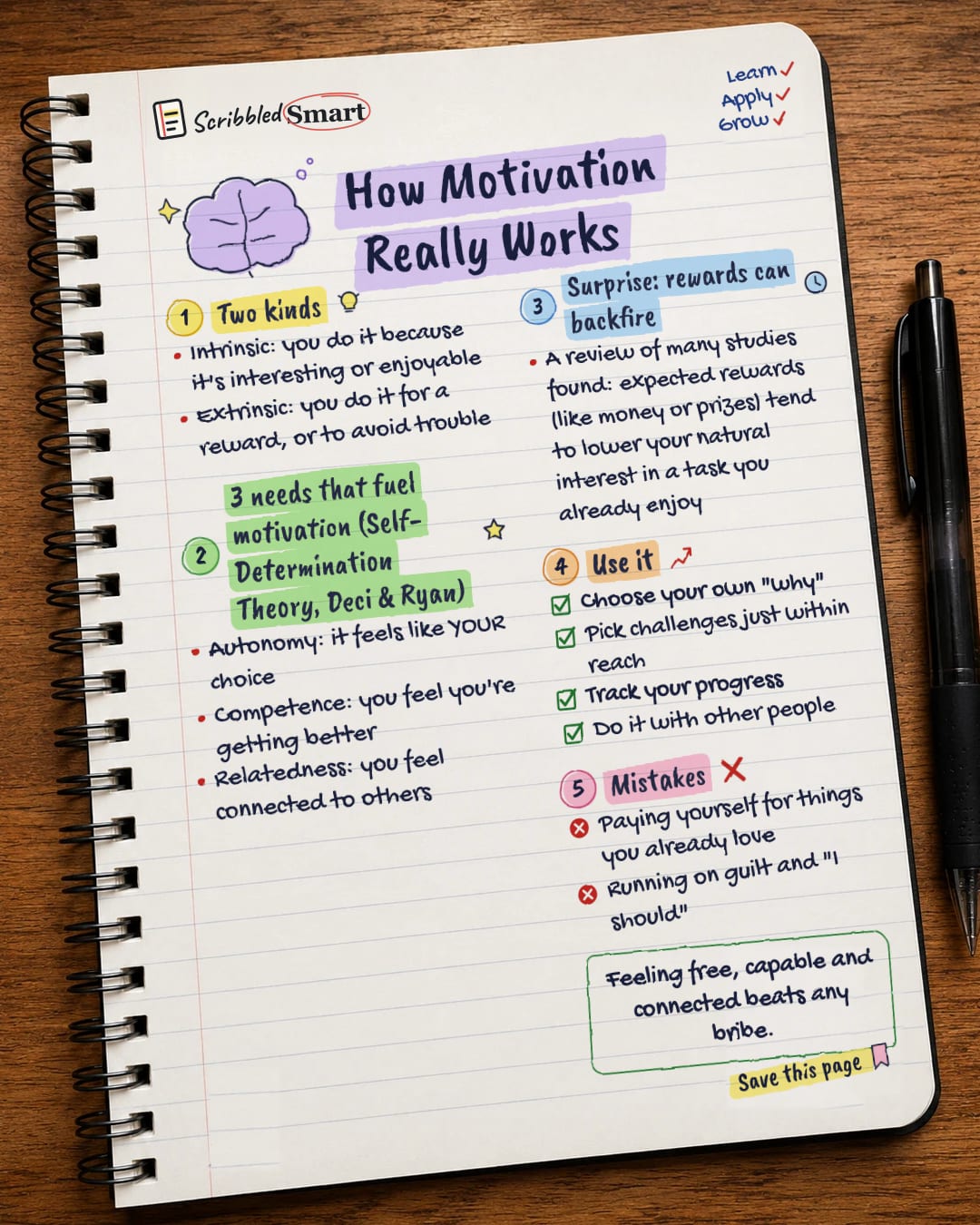
Motivation works best when three needs are met: feeling that a choice is yours, feeling that you're getting better, and feeling connected to other people. That is the core of Self-Determination Theory, developed by psychologists Edward Deci and Richard Ryan. This article explains how motivation works, the difference between doing something for its own sake and doing it for a reward, and why rewards can sometimes backfire.
What are the two kinds of motivation?
Motivation comes in two broad kinds: intrinsic and extrinsic. Ryan and Deci set out the difference in a well-known 2000 paper.
- Intrinsic motivation: you do something because it's interesting or enjoyable in itself.
- Extrinsic motivation: you do something for a separate outcome, such as a reward, or to avoid trouble.
It's more of a scale than a switch
Self-Determination Theory doesn't treat motivation as simply "on" or "off". It describes a continuum, from no motivation at all to fully intrinsic:
- Amotivation: no motivation.
- External: doing it for rewards or to avoid punishment.
- Introjected: doing it because of guilt or pressure ("I should").
- Identified and 5. Integrated: steps where the reasons feel more and more your own.
- Intrinsic: doing it because you enjoy it.
External and introjected motivation count as "controlled". Identified, integrated and intrinsic motivation count as "autonomous", meaning they come from you. The theory says autonomous motivation is more durable than controlled motivation.
How motivation works: the 3 needs that fuel it
Self-Determination Theory says we have three basic psychological needs. When they are met, motivation grows. Ryan and Deci's 2020 paper describes them like this:
| Need | What it means | How it feels |
|---|---|---|
| Autonomy | Initiative and ownership of your actions | It feels like your choice |
| Competence | Feeling effective | You feel you're getting better |
| Relatedness | Connection with others | You feel part of something |
That is the idea behind the side note on our page: feeling free, capable and connected is a sturdier fuel than a bribe.
Can rewards make you less motivated?
Expected rewards can lower your interest in something you already enjoy. This is sometimes called the overjustification effect.
What the research found
A 1999 meta-analysis by Deci, Koestner and Ryan in Psychological Bulletin combined many studies. It found that expected tangible rewards, like money or prizes, tend to undermine intrinsic motivation.
Why "a task you already enjoy" matters
The effect applies to interesting tasks. For a boring task, there is no intrinsic motivation to undermine in the first place.
Not all rewards are the same
Rewards aren't always bad. Verbal praise and unexpected rewards don't show the same undermining effect. That is why our page says "expected rewards" on purpose. Positive feedback can even boost intrinsic motivation, according to Cognitive Evaluation Theory, one of the sub-theories of Self-Determination Theory.
How to use this in everyday life
Each tip below links to one of the three needs.
Choose your own "why" (autonomy)
Find a reason that is genuinely yours. A goal you've chosen sits further along the autonomous end of the scale than one you're doing out of guilt. If you're building a routine, our guide to how habits really form shows how to make it automatic over time.
Pick challenges just within reach (competence)
Cognitive Evaluation Theory says optimal challenge supports competence. Too easy and there's nothing to master. Too hard and you feel stuck. Aim for "just within reach".
Track your progress (competence)
Seeing that you're improving feeds the competence need, in the same way positive feedback does.
Do it with other people (relatedness)
Doing something alongside others supports the need to feel connected.
For managers and teachers
Self-Determination Theory research in education and work suggests that managers and teachers can support autonomy by giving choice and explaining the reasons behind tasks.
Motivation mistakes to avoid
- Paying yourself for things you already love. Expected rewards can undermine your natural interest.
- Running on guilt and "I should". That is controlled motivation, which is less durable than reasons you've chosen.
- Waiting to "feel motivated". The three needs can be built through choices, challenge and company.
A note of caution
Self-Determination Theory isn't beyond question. Some critics ask whether its view of autonomy fits every culture equally. This criticism comes from secondary sources, so treat it as an open debate.
Related reading
- Why we procrastinate: what's happening when motivation won't show up.
- Active recall: a study method where you can see your own progress.
- Imposter syndrome explained: when you doubt your own competence.
Sources
- Ryan & Deci (2000): What and Why (PDF)
- Ryan & Deci (2020): Contemporary Educational Psychology preprint (PDF)
- Ryan & Deci (2022): SDT encyclopedia entry (PDF)
- Deci, Vallerand, Pelletier & Ryan (1991) (PDF)
How we checked this
Every fact in this article comes from the 4 sources listed above, checked against official or peer-reviewed sources where possible. AI tools help with drafting; a person checks every fact against the sources. How we research
- Published and checked
General info, not professional advice.
Spotted a mistake? Tell us and we'll fix it and log it on the corrections page.


