
On this page
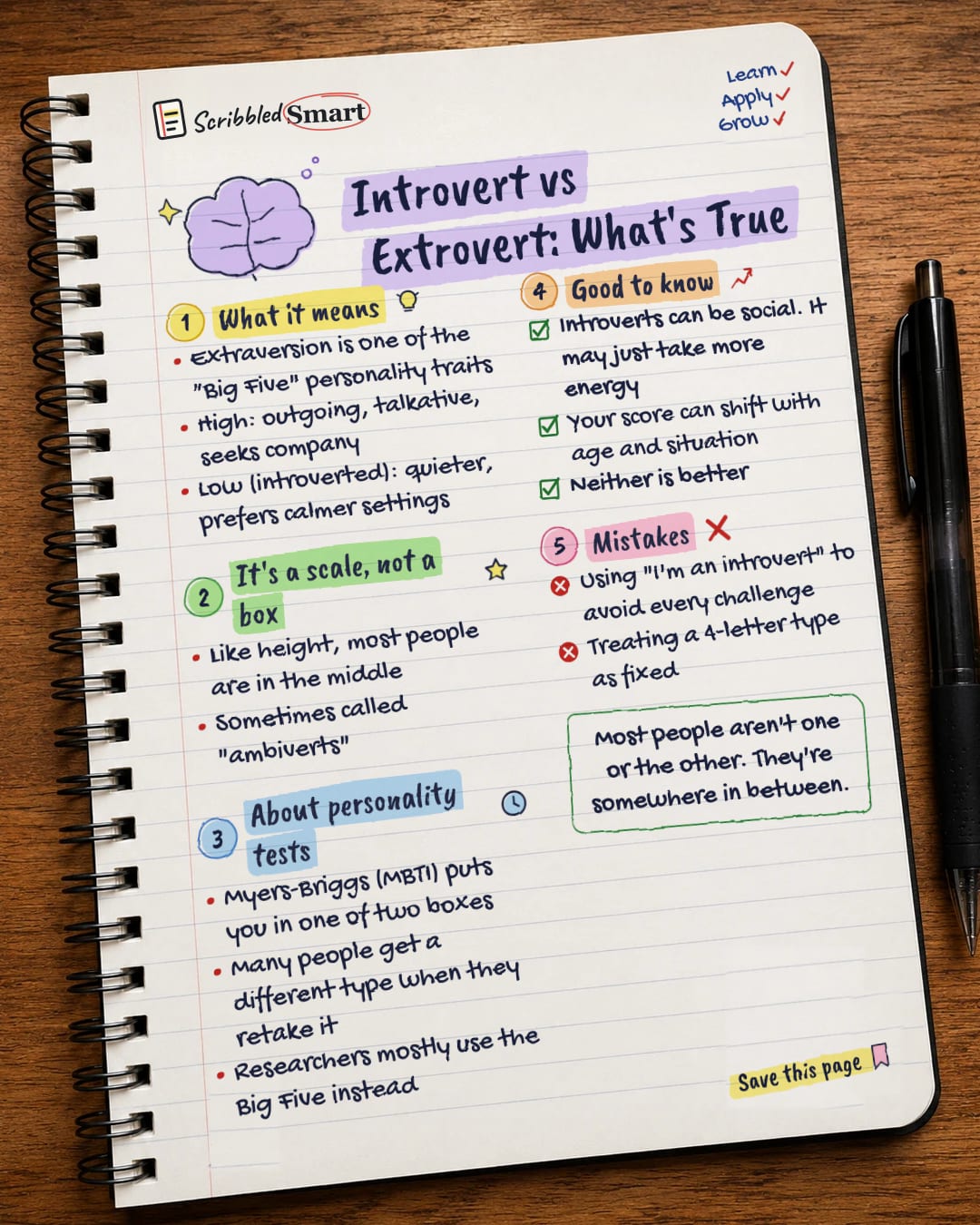
In the introvert vs extrovert debate, the research answer is that it's a scale, not a box, and most people sit somewhere in the middle. Extraversion is one of the "Big Five" personality traits that researchers use. Someone high in it tends to be outgoing and talkative, while someone low in it (more introverted) tends to be quieter. This article explains what the labels mean, why personality tests can mislead, and what's actually true.
What do introvert and extrovert mean?
Extraversion is one of the Big Five personality traits. Being an "extrovert" or "introvert" describes where you fall on that one trait.
- High extraversion: outgoing, talkative and seeks company.
- Low extraversion (introverted): quieter, less talkative and less drawn to company.
One modern measure of the Big Five is the BFI-2, published by Soto and John in 2017. It measures 15 more detailed "facet" traits that sit within the five big traits.
A note on "recharging"
You'll often hear that introverts "recharge alone". It's a popular way of putting it, but it isn't a precise Big Five definition, so we don't use it here.
Introvert vs extrovert is a scale, not a box
Most people are neither a pure introvert nor a pure extrovert. They are somewhere in between.
The organisational psychologist Adam Grant, of Wharton, explained this in a 2013 article. Like all personality traits, introversion–extraversion follows a bell shape. That means it's most common to be in the middle, just as most people are close to average height.
People in the middle are sometimes called "ambiverts". The side note on our page puts it simply: most people aren't one or the other.
Which personality test is better: MBTI or the Big Five?
Researchers mostly use the Big Five rather than the Myers-Briggs. It measures traits on a scale, and critics such as Adam Grant say it has stronger evidence behind it.
How the Myers-Briggs works
The Myers-Briggs Type Indicator (MBTI) sorts people into types. For this trait, it puts you in one of two boxes: Introversion or Extraversion. The Myers-Briggs Company itself says the MBTI identifies preferences and types, rather than measuring traits. So both supporters and critics agree it is a "type" test.
Retaking the test
Many people get a different MBTI type when they retake it. Grant gives a figure for this, but other numbers circulating online couldn't be traced back to a primary study. So we keep it simple: "many" people get a different result.
Why researchers prefer the Big Five
According to Grant, the Big Five has higher reliability (it gives more consistent results) and predicts job performance better than the MBTI. That is the mainstream academic view.
The Myers-Briggs Company disputes these criticisms. You can read its side in the sources below.
| Myers-Briggs (MBTI) | Big Five | |
|---|---|---|
| What it gives you | A type (a box) | A score on a scale |
| Introversion–extraversion | One of two categories | Anywhere along a range |
| Used mainly by researchers? | No | Yes |
What's actually true about introverts and extroverts
Introverts can be social
Being an introvert doesn't mean you can't be sociable. The Myers-Briggs Company says someone who prefers Introversion can still act in an extraverted way. It simply takes more of their energy.
Your score can shift with age
Personality isn't frozen. A 2006 meta-analysis by Roberts, Walton and Viechtbauer looked at 92 samples from long-term studies. It found that social dominance, a part of extraversion, tended to rise across life, especially between the ages of 20 and 40. Social vitality, another part, rose in the teenage years and then fell in old age.
Neither is better
There is no "better" end of the scale. Being high or low in extraversion is simply a difference between people.
If you're building a career, our guide on why acquaintances get you jobs is useful whatever your personality.
Common mistakes
- Using "I'm an introvert" to avoid every challenge. Introverts can be social. It may just take more energy.
- Treating a 4-letter type as fixed. Many people get a different MBTI type on a retest.
- Thinking you must be one or the other. Most people sit in the middle.
- Mocking personality tests. It's fairer to say researchers mostly use the Big Five.
Related reading
- Body language myths: more popular ideas about people, checked against research.
- How to prepare for a job interview: practical steps for any personality type.
- Imposter syndrome explained: another common label people use about themselves.
Sources
- Psychology Today: Adam Grant (2013), Goodbye to MBTI, the fad that won't die
- The Myers-Briggs Company: MBTI facts and common criticisms
- The Myers-Briggs Company: The Myers-Briggs is no fad (archived copy) (original page, no longer online: https://themyersbriggs.com/en-US/Connect-With-Us/Blog/the-myers-briggs-is-no-fad)
- Europe PMC: Roberts, Walton & Viechtbauer (2006), mean-level change in personality traits
- Soto & John (2017): The next Big Five Inventory (BFI-2)
How we checked this
Every fact in this article comes from the 5 sources listed above, checked against official or peer-reviewed sources where possible. AI tools help with drafting; a person checks every fact against the sources. How we research
- Published and checked
General info, not professional advice.
Spotted a mistake? Tell us and we'll fix it and log it on the corrections page.


