
On this page
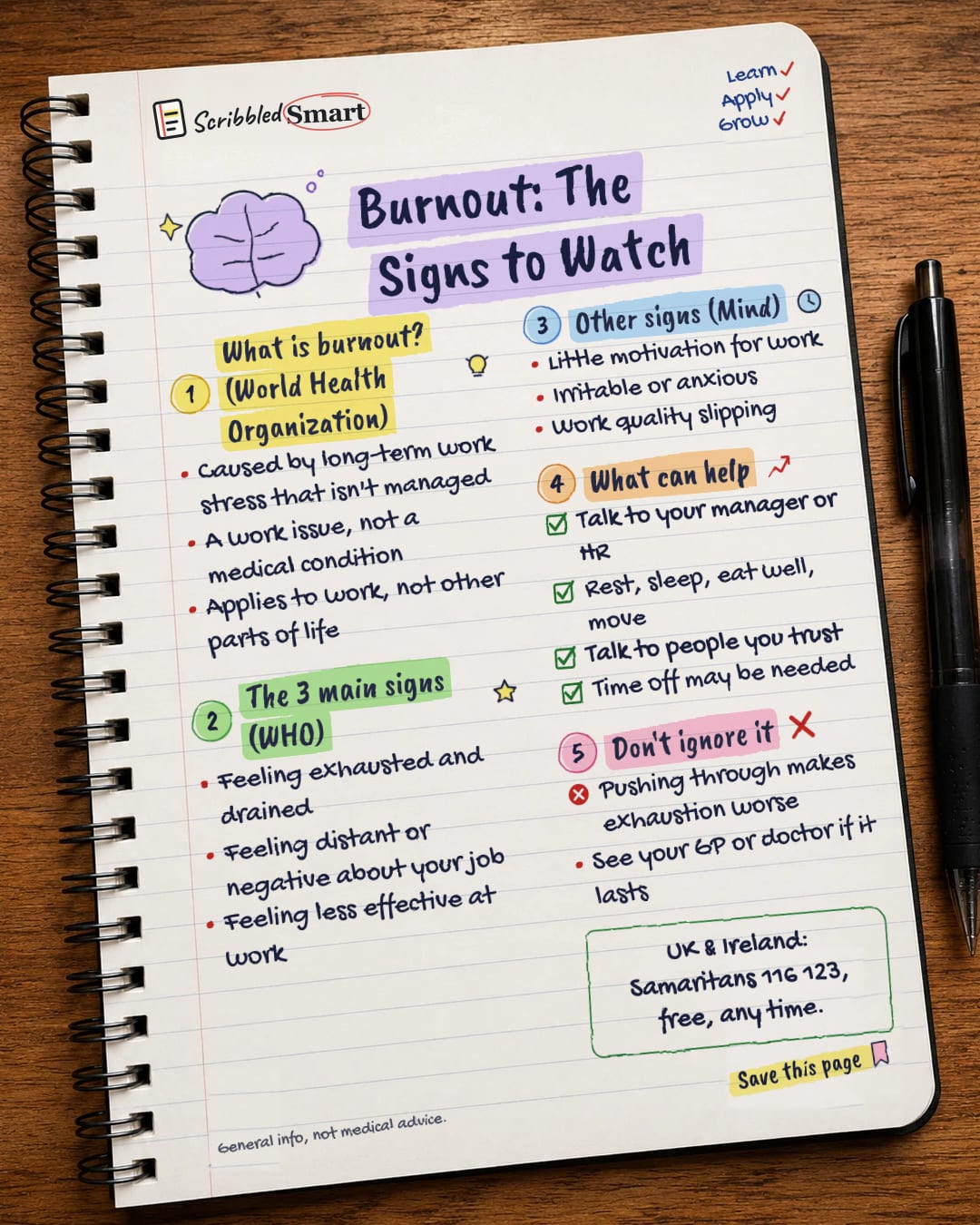
The three main signs of burnout, according to the World Health Organization (WHO), are feeling exhausted, feeling distant or negative about your job, and feeling less effective at work. Burnout isn't just being tired. It is caused by long-term work stress that hasn't been managed. This guide covers what burnout is, the signs to watch, what can help and when to get support.
What is burnout?
Burnout is a syndrome caused by chronic workplace stress that has not been successfully managed. That is the WHO's definition, announced on 28 May 2019.
A work issue, not a medical condition
The WHO calls burnout an "occupational phenomenon". It is listed in ICD-11, the WHO's International Classification of Diseases, under "factors influencing health status". It is not classified as a medical condition. So there is no such thing as a formal "burnout disorder".
ICD-11 took effect on 1 January 2022. Burnout was also in the older ICD-10, but it was defined less precisely there.
It only applies to work
The WHO definition refers to the work context only. It shouldn't be used to describe stress in other parts of life, such as relationships or caring at home. That stress is real, but by this definition it isn't "burnout".
What are the 3 main signs of burnout, according to the WHO?
The WHO lists three dimensions of burnout, which it uses to define the syndrome.
| WHO sign | What it can feel like |
|---|---|
| Exhaustion, or energy depletion | Feeling drained, with nothing left to give |
| Mental distance from your job, or feeling negative or cynical about it | Feeling detached, fed up or cynical about work |
| Reduced professional efficacy | Feeling less effective or capable at work |
These three signs match the main measure researchers use, the Maslach Burnout Inventory, created by Maslach and Jackson. A 2020 review notes that this measure is the most often cited, though it also points out that it has no representative reference values and that its validity has never been proved.
Other signs of burnout to watch (Mind)
Mind, the UK mental health charity, describes other signs too. They include:
- having little motivation for work
- feeling irritable or anxious
- your work quality or performance slipping
Why the signs matter
Mind warns that ignoring the signs can leave you emotionally and mentally exhausted. That is why pushing through on your own isn't a good plan.
Burnout or something else?
The signs of burnout overlap with depression. That is one reason to see your GP or doctor if the signs last. A GP is a family doctor in the UK.
What can help with burnout?
The charities suggest a mix of changes at work and looking after yourself. Here is what they recommend.
Talk to your manager or HR
Mind's workplace guidance suggests talking to your employer. Burnout comes from work stress that hasn't been managed, so work is part of the fix.
🇬🇧 UK only: the Health and Safety Executive (HSE) says employers have a legal duty to protect employees from stress at work. That means assessing the risk of work-related stress and acting on the results. The HSE's Management Standards cover six areas: demands, control, support, relationships, role and change.
Rest, sleep, eat well and move
Samaritans' self-help guidance suggests resting, eating well, sleeping and exercising. Our guide on how to sleep better covers the NHS basics.
Talk to people you trust
Samaritans also recommends talking to people you trust. You don't have to deal with it alone.
Time off may be needed
Mind says professional support and time off may be needed. Taking a break isn't failing. It can be part of recovering.
Common burnout mistakes
- Pushing through. Ignoring the signs can make exhaustion worse.
- Calling it a medical condition. The WHO says burnout is an occupational phenomenon, not a diagnosis.
- Waiting too long to get help. If the signs last, see your GP or doctor.
- Thinking it's only about being tired. Feeling distant from your job and less effective are signs too.
When to get help
See your GP or doctor if the signs of burnout last. If you need to talk to someone now:
🇬🇧 UK and Republic of Ireland: Samaritans, 116 123, free and open 24/7.
Related reading
- Stress: what it does to your body: the physical side of long-term stress.
- Check email less, stress less: one small way to reduce daily work pressure.
- Your basic rights at work (UK): what your employer owes you.
Sources
- WHO: Burn-out an "occupational phenomenon" (2019)
- WHO FAQ: Burn-out an occupational phenomenon
- Mind: Working in Westminster guide (PDF, burnout section)
- Samaritans: Signs you may be struggling to cope
- Samaritans: Contact us
- NCBI: The Burnout Phenomenon, a résumé after more than 15,000 publications
- HSE: What are the Management Standards?
How we checked this
Every fact in this article comes from the 7 sources listed above, checked against official or peer-reviewed sources where possible. AI tools help with drafting; a person checks every fact against the sources. How we research
- Published and checked
- Next check
- Yearly
General info, not medical advice. UK and Ireland: Samaritans 116 123, free, any time.
Spotted a mistake? Tell us and we'll fix it and log it on the corrections page.


