
On this page
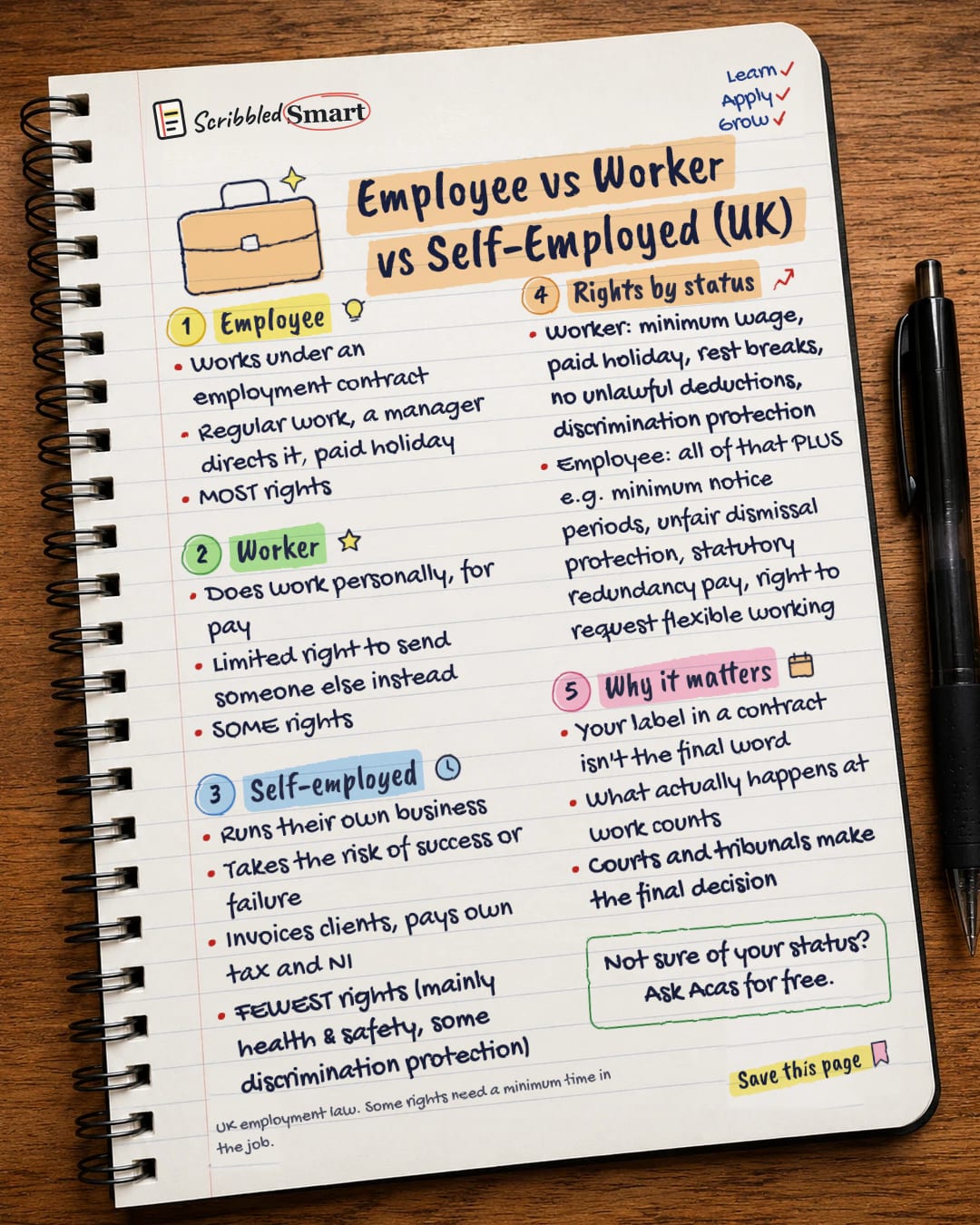
🇬🇧 UK only. The difference between employee vs worker vs self-employed comes down to how you work: employees work under an employment contract and get the most rights, workers do work personally for pay and get some rights, and self-employed people run their own business and get the fewest. Your status matters because it decides which legal protections you have. This guide explains each status in plain English, using GOV.UK's employment status guidance.
The three employment statuses at a glance
| Employee | Worker | Self-employed | |
|---|---|---|---|
| Basic idea | Works under an employment contract | Does work personally, for pay | Runs their own business |
| Rights | Most | Some | Fewest |
The sections below explain each one, then compare the rights side by side.
What is an employee?
An employee is someone who works under an employment contract. GOV.UK lists signs that you're likely to be an employee, including:
- You get regular work.
- A manager directs your work.
- You get paid holiday.
Employees get the widest set of rights of the three groups.
What is a worker?
A worker has a contract or other arrangement to do work personally, in return for a reward such as money. Personally is the word that matters most: GOV.UK says a worker has only a limited right to send someone else to do the work in their place.
Workers have fewer rights than employees, but more than the self-employed.
What does self-employed mean?
A self-employed person runs their business for themselves and takes responsibility for whether it succeeds or fails. According to GOV.UK, self-employed people typically:
- Bid for work.
- Send invoices to clients for the work they do.
- Pay their own National Insurance and tax.
Self-employed people get the fewest employment rights. GOV.UK says they're mainly protected for health and safety, and in some cases against discrimination.
Employee vs worker vs self-employed: rights compared
Your rights build up as you move from self-employed to worker to employee. Employees get everything workers get, plus more.
Rights for workers
GOV.UK lists these rights for workers:
- The National Minimum Wage
- Protection against unlawful deductions from pay
- Paid holiday
- Rest breaks
- Limits on working time
- Protection against discrimination
- Protection for whistleblowing (reporting wrongdoing)
- Protection for part-time workers
Extra rights for employees
Employees get all the worker rights above, plus extra ones. GOV.UK's examples include:
- Minimum notice periods
- Protection against unfair dismissal
- The right to request flexible working
- Time off for emergencies
- Statutory Redundancy Pay
- Statutory family leave, such as maternity, paternity and shared parental leave
GOV.UK's worker page adds that workers may also be entitled to some statutory payments, such as Statutory Sick Pay and Statutory Maternity Pay. The statutory leave that goes with them is for employees only.
Some rights depend on how long you've worked there
Some employee rights only start after you've worked for an employer for a minimum length of time. We've deliberately left out the exact time periods, because they're changing under the Employment Rights Act 2025. Check the current GOV.UK guidance for the latest rules.
For the basics that most workers get, such as minimum pay rates and holiday, see our guide to your basic rights at work in the UK.
Can your employer just call you self-employed?
Not on its own say-so. Your status is decided by what really happens at work, not just by what your contract says. GOV.UK makes three points:
- The label in your contract isn't the final word. Being called "self-employed" or a "contractor" on paper doesn't settle it.
- What actually happens at work counts, such as whether a manager directs you and whether you can send someone else.
- Courts and tribunals make the final decision if there's a dispute.
Tax status can be different
GOV.UK also notes that your status for tax purposes can be different from your status for employment rights. So being treated one way by the tax system doesn't automatically decide your rights at work.
Tips if you're unsure of your status
- ✓ Compare how you really work with the signs above, not just the job title or contract wording.
- ✓ Keep records: your contract, emails about how work is given to you, and your payslips or invoices.
- ✓ Get free advice from Acas. GOV.UK's employment status guidance points people to Acas. In Northern Ireland, contact the Labour Relations Agency instead.
Related reading
- Your basic rights at work (UK): minimum pay, holiday, written statements and payslips.
- How to read your payslip (UK): understand each line of what you're paid.
- ISA vs pension (UK): ways to save for later, whatever your status.
Sources
- GOV.UK: Employment status
- GOV.UK: Employment status, worker
- GOV.UK: Employment status, employee
- GOV.UK: Employment status, self-employed and contractor
How we checked this
Every fact in this article comes from the 4 sources listed above, checked against official or peer-reviewed sources where possible. AI tools help with drafting; a person checks every fact against the sources. How we research
- Published and checked
- Next check
- Yearly (Employment Rights Act 2025 changes are phasing in)
🇬🇧 UK employment law. Some rights need a minimum time in the job. General info, not legal advice.
Spotted a mistake? Tell us and we'll fix it and log it on the corrections page.


