
On this page
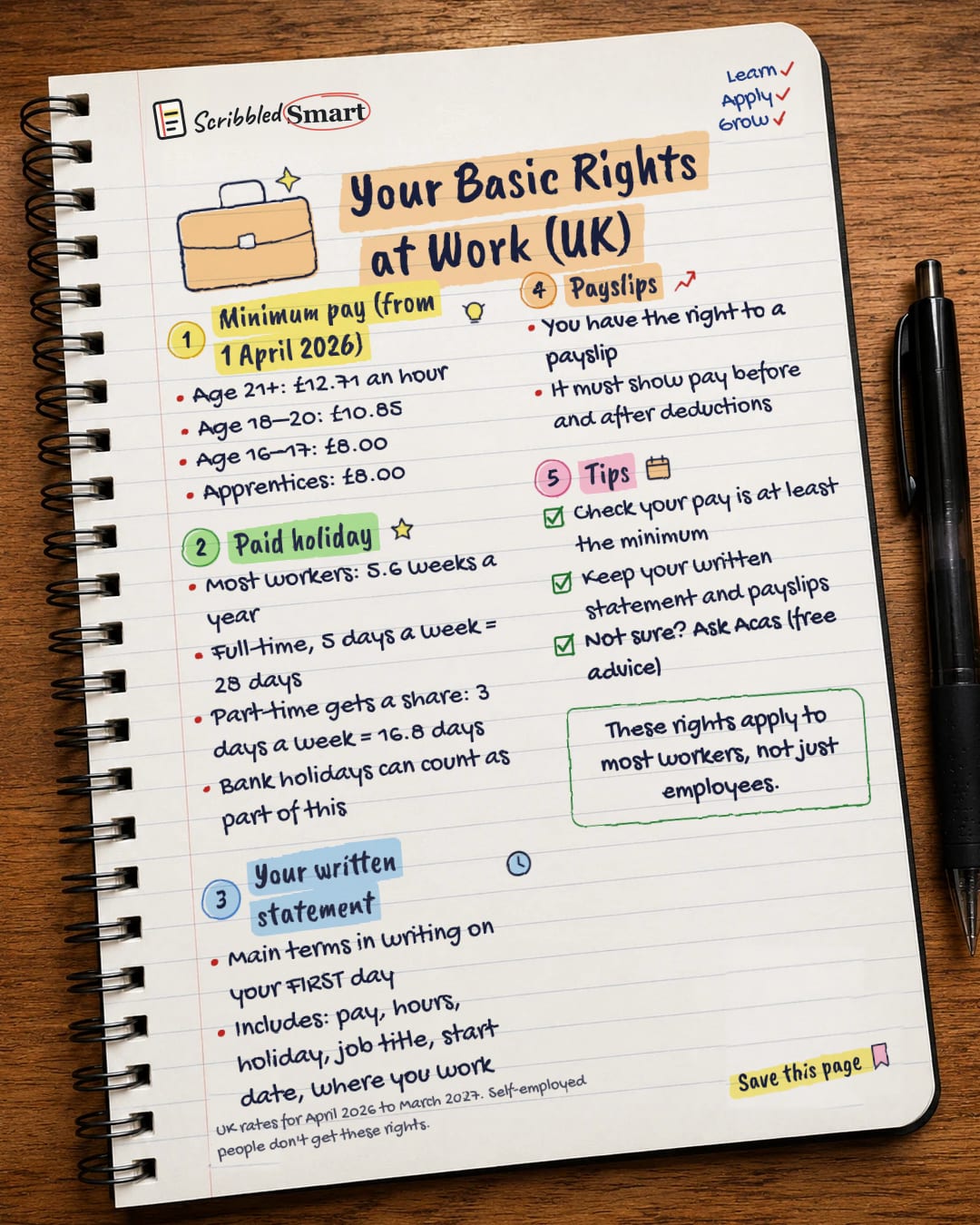
🇬🇧 UK only. Your basic rights at work in the UK include at least the minimum wage for your age, 5.6 weeks' paid holiday a year, the main terms of your job in writing on your first day, and a payslip. These rights apply to most workers, not just employees. This guide explains each one using the rates for April 2026 to March 2027, with simple worked examples.
Who do these rights at work cover in the UK?
These basic rights cover most workers, not only people with an employee contract. GOV.UK's guidance on employment status says workers are entitled to things like the minimum wage and paid holiday.
People who are genuinely self-employed don't get these rights. If you're not sure which group you're in, our guide to employee vs worker vs self-employed status in the UK explains the difference.
What is the minimum wage from 1 April 2026?
Your employer must pay you at least the legal minimum hourly rate for your age. These are the rates from 1 April 2026, according to GOV.UK:
| Age or status | Minimum hourly rate |
|---|---|
| 21 and over (the National Living Wage) | £12.71 |
| 18 to 20 | £10.85 |
| Under 18 (and over school leaving age) | £8.00 |
| Apprentice | £8.00 |
Who gets the apprentice rate?
The apprentice rate isn't for every apprentice. GOV.UK says apprentices are entitled to it if they're under 19, or if they're 19 or over and in the first year of their apprenticeship. After that, the normal rate for your age applies.
These rates change on 1 April every year. The rates above apply from April 2026 to March 2027. GOV.UK has already published the rates from 1 April 2027: £13.21 for 21 and over, £11.27 for 18 to 20, and £8.31 for under-18s and apprentices. We'll update this article when they take effect.
How much paid holiday should you get?
Most workers are entitled to 5.6 weeks of paid holiday a year. To turn weeks into days, multiply 5.6 by the number of days you work each week.
| Days worked per week | Calculation | Paid holiday per year |
|---|---|---|
| 5 days (full-time) | 5.6 × 5 | 28 days |
| 3 days (part-time) | 5.6 × 3 | 16.8 days |
GOV.UK sets a statutory cap of 28 days, so someone working 6 days a week still gets 28 days of statutory holiday. Part-time workers get a share in proportion to the days they work, which is why 3 days a week gives 16.8 days. Acas uses the same kind of example.
Do bank holidays count?
They can. GOV.UK says your employer can include bank holidays as part of your statutory holiday. There's no automatic legal right to have bank holidays off. Check your written statement to see how your employer handles them.
Your written statement on day one
Your employer must give you the main terms of your job in writing on your first day. GOV.UK calls this the "principal statement", part of the written statement of employment particulars. It must be given to both employees and workers.
The principal statement includes things like:
- Your name and your employer's name
- Your job title
- Your start date
- Your pay
- Your hours
- Your holiday
- Where you work
GOV.UK lists more items than these, such as any probation period and other benefits. Keep this document somewhere safe. If there's ever a disagreement about your pay or hours, it's your written record of what was agreed.
Your right to a payslip
You have the right to a payslip. GOV.UK says it must show:
- Your gross pay: your pay before deductions.
- Your deductions.
- Your net pay: what you take home after deductions.
Our guide on how to read your payslip walks through each line.
Tips to protect your rights at work
- ✓ Check your pay is at least the minimum. Divide your pay by your hours and compare it with the table above.
- ✓ Keep your written statement and payslips. They're your evidence if something goes wrong.
- ✓ Check your holiday adds up. Use 5.6 × your working days (up to 28).
- ✓ Not sure? Ask Acas. Acas gives free advice on rights at work. In Northern Ireland, contact the Labour Relations Agency instead.
The law is changing
The Employment Rights Act 2025 is bringing in changes to UK employment rights in stages. This article doesn't cover those changes. Before relying on any rule, check the current guidance on GOV.UK.
Related reading
- Employee vs worker vs self-employed (UK): which rights you get depends on your employment status.
- How to read your payslip (UK): understand every line on the payslip you're entitled to.
- Signs of burnout: spot the warning signs if work is wearing you down.
- How to negotiate your salary: the minimum is the floor, not the target.
Sources
- GOV.UK: National Living Wage increases to £12.71 per hour
- GOV.UK: Minimum wage rates for 2026
- GOV.UK: National Minimum Wage and National Living Wage rates
- GOV.UK: Holiday entitlement
- Acas: Checking holiday entitlement (original page, no longer online: https://beta.acas.org.uk/holiday-entitlement/how-much-holiday-you-should-get)
- GOV.UK: Written statement of employment particulars
- GOV.UK: Payslips
- GOV.UK: Employment status, worker
How we checked this
Every fact in this article comes from the 8 sources listed above, checked against official or peer-reviewed sources where possible. AI tools help with drafting; a person checks every fact against the sources. How we research
- Published and checked
- Next check
- Every April (new minimum wage rates). Update before 1 April 2027.
🇬🇧 UK only. Rates for April 2026 to March 2027. Self-employed people don't get these rights. General info, not legal advice.
Spotted a mistake? Tell us and we'll fix it and log it on the corrections page.


