
On this page
- The two sides in the World War II timeline
- 1939: how did the war begin?
- 1940: the fall of France and the Battle of Britain
- 1941: the year it became a world war
- 1942 to 1944: the turning point
- 1945: how did the war end?
- The Holocaust
- How many people died in World War II?
- Tips for learning the dates
- Related reading
- Sources
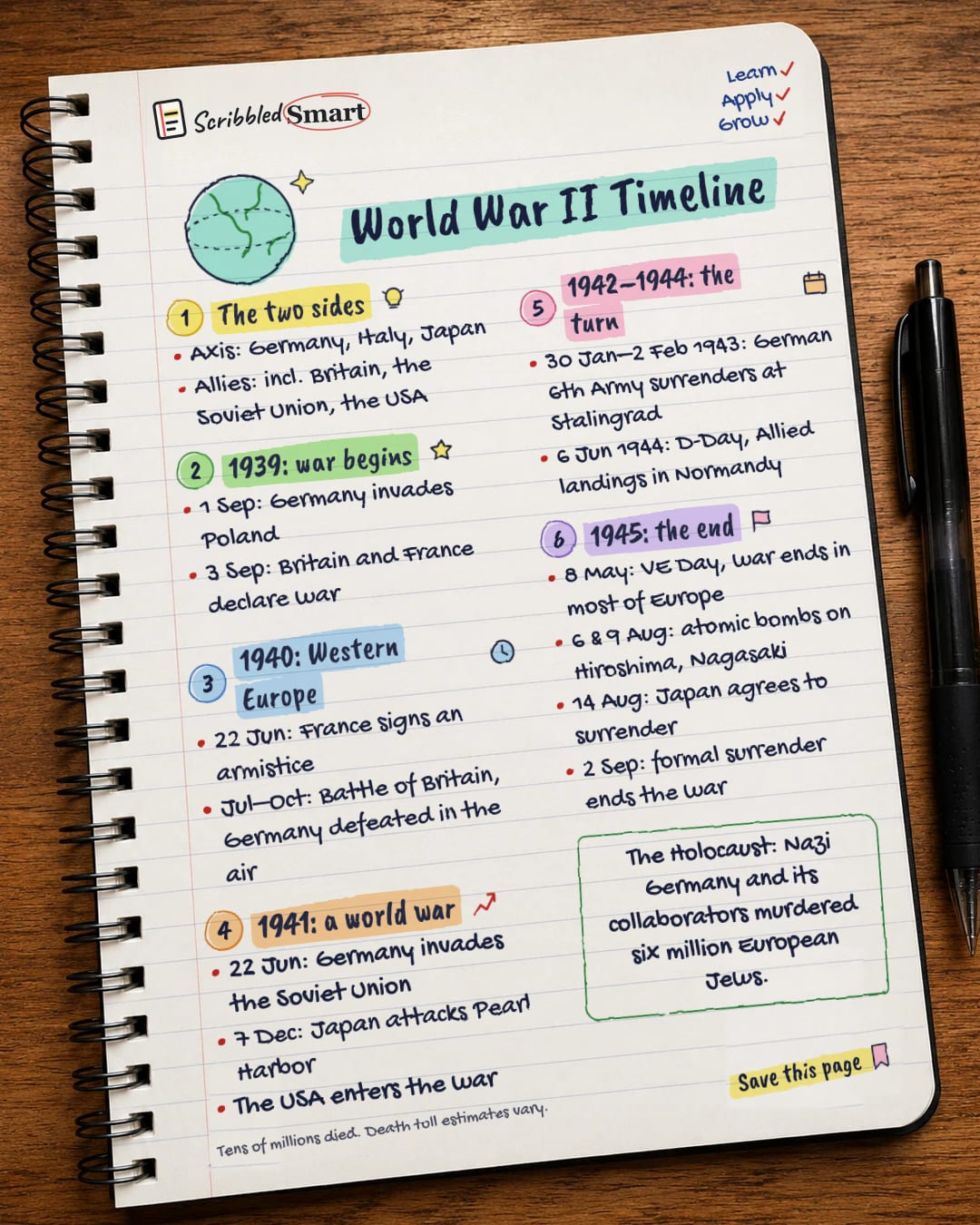
This World War II timeline runs from 1 September 1939, when Germany invaded Poland, to 2 September 1945, when Japan's formal surrender ended the war. In between came six years of fighting that drew in countries around the world. Below are the two sides and the dates that mattered most, year by year, with dates as they are marked in the UK.
The two sides in the World War II timeline
World War II was fought between two groups of countries: the Axis and the Allies.
- The Axis: Germany, Italy and Japan. The three signed the Tripartite Pact on 27 September 1940.
- The Allies: these included Britain, the Soviet Union and the USA, along with many others such as China, France, Poland, Canada, Australia and India.
1939: how did the war begin?
The war in Europe started when Germany invaded Poland on 1 September 1939.
| Date | Event |
|---|---|
| 1 September 1939 | Germany invades Poland |
| 3 September 1939 | Britain and France declare war on Germany |
| 17 September 1939 | The Soviet Union invades Poland from the east |
The war in Asia is sometimes dated from earlier, when Japan invaded China in 1937. This timeline uses the common European start date.
1940: the fall of France and the Battle of Britain
In 1940, France signed an armistice with Germany, but Germany lost the fight for the skies over Britain.
| Date | Event |
|---|---|
| 10 June 1940 | Italy enters the war |
| 22 June 1940 | France signs an armistice (an agreement to stop fighting) |
| 10 July–31 October 1940 | Battle of Britain, which ends in defeat for Nazi Germany |
| 27 September 1940 | Germany, Italy and Japan sign the Tripartite Pact |
The Battle of Britain was fought in the air. The US Holocaust Memorial Museum (USHMM) records that it ended in German defeat.
1941: the year it became a world war
Two attacks in 1941 pulled the Soviet Union and the USA fully into the war.
| Date | Event |
|---|---|
| 22 June 1941 | Germany and its Axis partners invade the Soviet Union |
| 7 December 1941 | Japan bombs Pearl Harbor |
| 8 December 1941 | The USA declares war on Japan |
| 11–13 December 1941 | Germany and its partners declare war on the USA |
1942 to 1944: the turning point
In 1943, Soviet forces took the initiative on the Eastern Front, and in 1944 the Allies opened a new front in France.
| Date | Event |
|---|---|
| 30 January and 2 February 1943 | Survivors of the German 6th Army surrender at Stalingrad |
| 6 June 1944 | D-Day: British, US and Canadian troops land in Normandy |
D-Day was the start of the Allied landings in Normandy, in northern France. The USHMM describes it as opening a "Second Front" against the Germans. In the east, the USHMM says that after a failed German attack at Kursk in July 1943, Soviet troops took a military initiative they never gave up.
1945: how did the war end?
The war ended in two stages: first in Europe in May, then in Asia and the Pacific in August and September.
| Date | Event |
|---|---|
| 7 May 1945 | Germany's surrender is signed at Reims |
| 8 May 1945 | VE Day: the surrender takes effect, and victory in Europe is marked |
| 6 August 1945 | Atomic bomb dropped on Hiroshima |
| 9 August 1945 | Atomic bomb dropped on Nagasaki |
| 15 August 1945 | VJ Day in the UK: Japan publicly announces its surrender |
| 2 September 1945 | Japan's formal surrender, signed aboard USS Missouri in Tokyo Bay, ends the war |
A second German surrender document was also signed in Berlin.
Why are there two VJ Days?
The UK marks VJ Day on 15 August, the day Japan announced its surrender. The USA marks 2 September, the day of the formal signing.
The Holocaust
The Holocaust was the systematic, state-sponsored persecution and murder of six million European Jews by Nazi Germany, its allies and collaborators.
How many people died in World War II?
Tens of millions of people died in World War II, but sources do not agree on an exact total. The USHMM gives an estimated 55 million and says statistics vary. Many other sources give much higher figures, from 70 to 85 million. Because the estimates differ so widely, we do not give a single number.
Tips for learning the dates
- Learn the bookends first: 1 September 1939 and 2 September 1945.
- Group by year: each year above has one or two headline events.
- Test yourself instead of re-reading. Our guide to spaced repetition shows how to space your practice so dates stick.
Related reading
- How UK general elections work: how Britain chooses its government today.
- The seven continents: a quick map of the world the war was fought across.
- Active recall: test yourself on these dates instead of just re-reading.
Sources
- USHMM Holocaust Encyclopedia: World War II key dates
- USHMM Holocaust Encyclopedia: World War II in depth
- USHMM Holocaust Encyclopedia: Introduction to the Holocaust
- Imperial War Museums: What was VJ Day?
- Imperial War Museums: VJ Day and the end of the Second World War
- Imperial War Museums: Beyond VE Day, the events of summer 1945
How we checked this
Every fact in this article comes from the 6 sources listed above, checked against official or peer-reviewed sources where possible. AI tools help with drafting; a person checks every fact against the sources. How we research
- Published and checked
Spotted a mistake? Tell us and we'll fix it and log it on the corrections page.


