
On this page
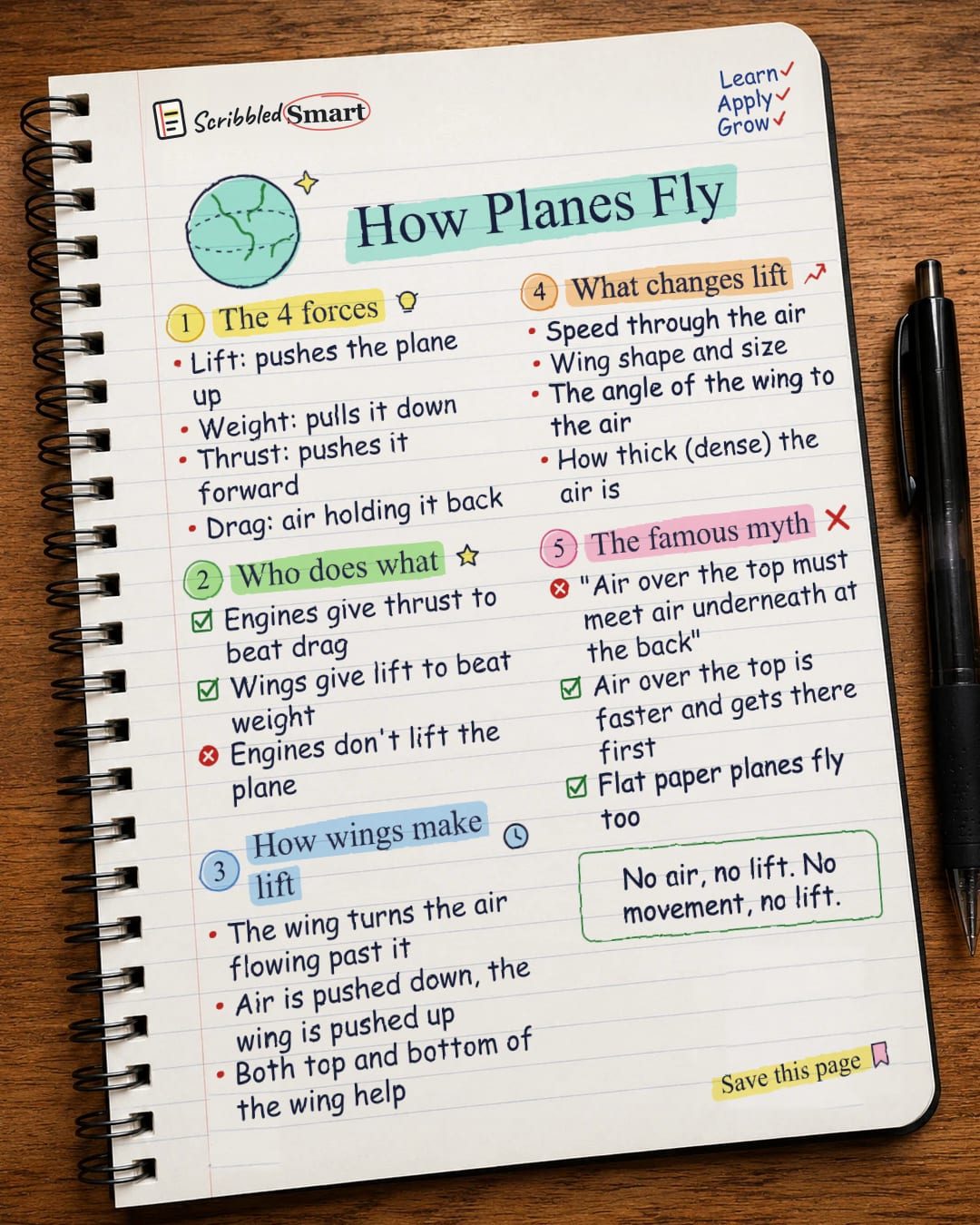
How planes fly comes down to two jobs: the engines push the plane forward, and as air flows past the wings, the wings turn that air downwards, which pushes the wings up. That upward push is called lift, and when it is at least as strong as the plane's weight, the plane stays in the air. Everything below comes from NASA's Glenn Research Center guide for beginners. We cover the four forces, who does what, what changes lift, and a famous explanation that turns out to be wrong.
What are the four forces of flight?
Every plane in flight has four forces acting on it, in two opposing pairs. NASA describes them like this:
| Force | Direction | What it is |
|---|---|---|
| Lift | Up | The force that holds the plane in the air |
| Weight | Down | Gravity pulling the plane towards Earth |
| Thrust | Forward | The push from the engines |
| Drag | Back | Air resistance holding the plane back |
Lift works against weight. Thrust works against drag.
Where each force acts
NASA adds one more detail. Weight acts through a point called the centre of gravity. Lift acts through a different point, the centre of pressure.
Balanced and unbalanced
When the four forces are balanced, NASA says the plane cruises at a constant velocity: a steady speed in a steady direction. When the forces are unbalanced, the plane accelerates.
Do the engines or the wings hold a plane up?
Engines and wings have different jobs. It is easy to assume the engines hold the plane up, but NASA is clear that the wings do the lifting.
- Engines give thrust, which overcomes drag and keeps the plane moving forward.
- Wings do the lifting, which overcomes weight.
How planes fly: wings make lift by turning air
A wing makes lift by changing the direction of the air flowing past it. NASA explains that lift happens when a moving flow of gas is turned by a solid object.
The flow is turned one way, and the lift goes the opposite way. This is Newton's third law at work: every action has an equal and opposite reaction. So the wing pushes air down, and the air pushes the wing up.
Both sides of the wing help
It is not only the top or only the bottom of the wing that matters. NASA says both the upper and lower surfaces help turn the flow.
What about pressure?
You may have heard that air moves faster over the top of a wing. That is true. NASA says faster air on top does mean lower pressure there, and that pressure idea is sound. This is often linked to the name Bernoulli. The problem is not the pressure idea. It is one wrong assumption that often comes with it (see the myth below).
What changes how much lift a wing makes?
NASA lists the main things that change lift:
- Speed: how fast the plane moves through the air.
- Wing shape and size.
- Angle: the angle of the wing to the oncoming air.
- Air density: how thick, or dense, the air is.
NASA also mentions two more technical factors, the air's viscosity and compressibility. Density is the easy one to picture.
This leads to two simple rules from NASA. No air, no lift: a wing needs something to turn. No movement, no lift: the air has to be flowing past the wing.
The famous myth: "air has to meet at the back"
A popular explanation says air going over the curved top of a wing has further to travel, so it must speed up to meet the air underneath at the back edge at the same time. This is called the equal transit theory, and NASA says it is wrong.
NASA gives three reasons:
- The air doesn't meet up. Air over the top actually moves faster than the theory predicts and reaches the back of the wing first.
- Flat wings fly. Paper planes with flat wings, and wings that are the same shape top and bottom, still make lift.
- Some wings break the rule. Some modern low-drag wings have a longer bottom surface, and planes can fly upside down. Both would be impossible if the theory were right.
Common mistakes
- "The engines hold the plane up." No, engines give thrust. Wings give lift.
- "Only the top of the wing matters." Both surfaces help turn the air.
- "Bernoulli is wrong." The pressure idea is sound. Only the equal transit assumption is wrong.
Flying soon? Our checklist for flying from the UK covers the practical side.
Related reading
- World War II timeline: including the Battle of Britain, fought in the air in 1940.
- Why the sky is blue: more physics of the air above us.
- The Feynman technique: try explaining lift in your own words to check you have it.
Sources
- NASA Glenn Research Center, Beginner's Guide to Aeronautics: Four Forces on an Airplane
- NASA Glenn: What is Lift?
- NASA Glenn: Factors that Affect Lift
- NASA Glenn: Equal Transit Theory Interactive (incorrect theory)
How we checked this
Every fact in this article comes from the 4 sources listed above, checked against official or peer-reviewed sources where possible. AI tools help with drafting; a person checks every fact against the sources. How we research
- Published and checked
Spotted a mistake? Tell us and we'll fix it and log it on the corrections page.


