
On this page
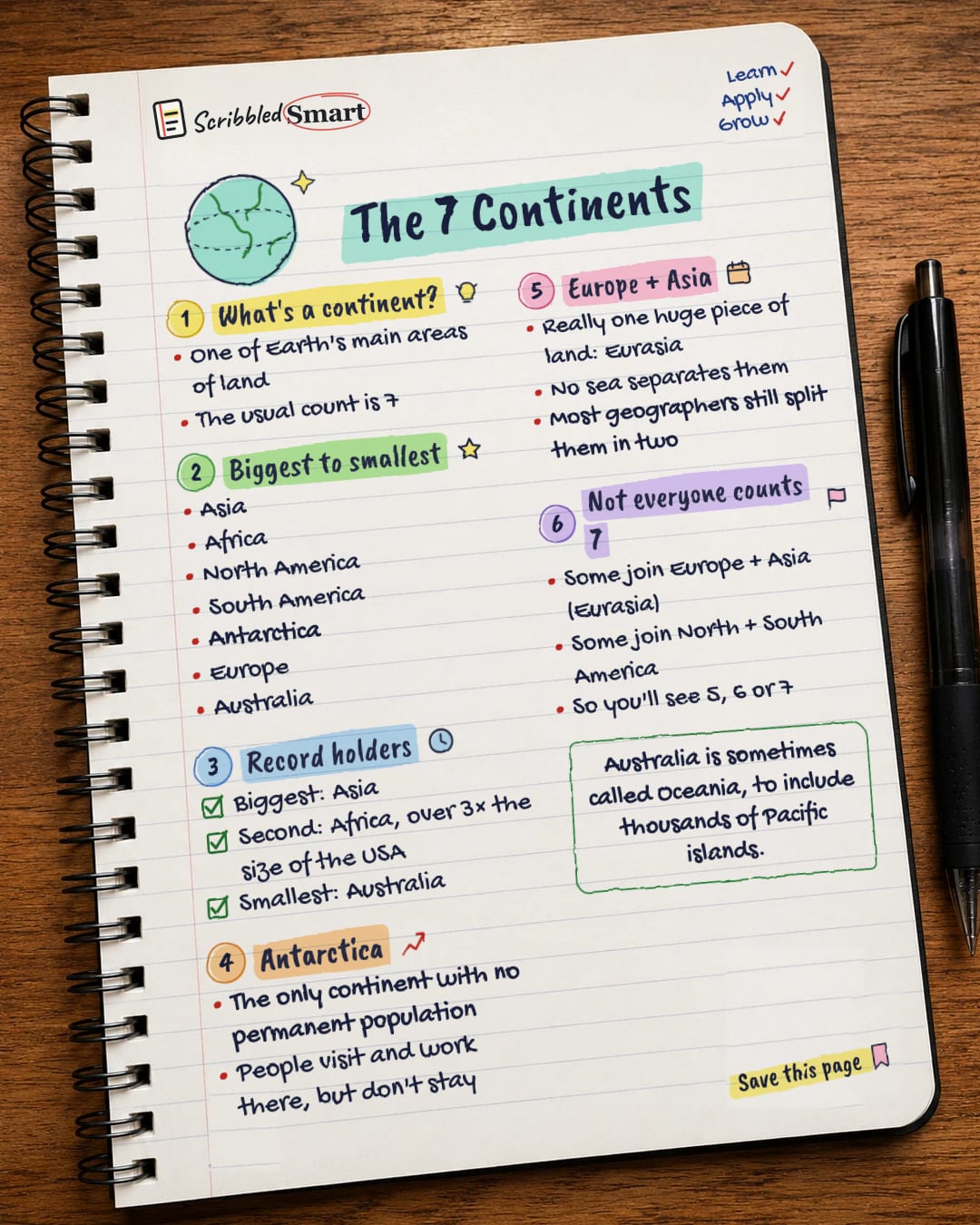
The 7 continents, from biggest to smallest, are Asia, Africa, North America, South America, Antarctica, Europe and Australia. That is the usual count, used by National Geographic. But there is no official rule, so you will also see the world split into 5 or 6 continents. This page covers the order, the record holders, the odd ones out, and why the number changes depending on who you ask.
What counts as a continent?
A continent is one of Earth's main divisions of land. National Geographic describes it as one of the seven main divisions.
There is no single official definition, though. WorldAtlas points out that there are no official criteria for what makes a continent. Geologists add another layer: they also define continents by continental crust and tectonic plates, which can give different answers again.
The 7 continents in order of size
Here are the seven, from largest to smallest, as listed by National Geographic:
- Asia
- Africa
- North America
- South America
- Antarctica
- Europe
- Australia
Exact areas are not given here on purpose. They vary between sources, partly because people disagree about where boundaries such as the edge of Europe should go.
North America's reach
North America stretches a long way. National Geographic says it runs from the Aleutian Islands down to the Isthmus of Panama.
Record holders
Three continents hold the headline records.
| Record | Continent | Detail |
|---|---|---|
| Biggest | Asia | The largest continent |
| Second biggest | Africa | More than three times the area of the United States |
| Smallest | Australia | The smallest continent |
Antarctica: the continent nobody lives on
Antarctica is the only continent with no permanent human population.
People do go there. Its research stations are staffed by people who rotate in and out rather than settling. So people visit and work there, but nobody stays for good.
Europe and Asia: really one landmass
Europe and Asia sit on one huge, connected piece of land called Eurasia. National Geographic notes that most geographers still divide it into two continents.
No sea separates them. Secondary sources such as WorldAtlas describe the border between Europe and Asia as a land convention: a line people agreed on, not a natural gap of water.
Why do some people count fewer than 7 continents?
You will see 5, 6 or 7 continents, depending on the model used. Several explainers, including HowStuffWorks, WorldAtlas and Cognito, describe the main versions:
| Model | What changes |
|---|---|
| 7 continents | Asia, Africa, North America, South America, Antarctica, Europe, Australia |
| 6 continents | Europe and Asia joined as Eurasia |
| 6 continents | North and South America joined as America |
| 5 continents | Fewer still, by joining continents together |
Which countries teach which model is harder to pin down. Sources disagree on the details, so we leave that out.
Is the smallest continent Australia or Oceania?
The smallest continent goes by two names. National Geographic uses "Australia", but it is sometimes called Oceania to include the thousands of islands in the Pacific. The UK revision site Cognito lists it as "Australia (sometimes called Oceania)", so you may see either name.
New Zealand is a good example of why the edges are fuzzy. National Geographic describes it as part of a microcontinent.
Tips for remembering them
- Learn them in size order. Asia, Africa, North America, South America, Antarctica, Europe, Australia.
- Spot the pairs. North and South America sit next to each other in the list, as do Europe and Australia at the small end.
- Know both names for the smallest one, Australia and Oceania, so neither one catches you out in a quiz.
Heading off to see a few of them? Our travel checklist for flying from the UK covers what to sort before you go.
FAQ
How many continents are there?
The usual answer is seven: Asia, Africa, North America, South America, Antarctica, Europe and Australia. But there is no official count. Some models join Europe and Asia into Eurasia, or North and South America into one America, which gives six. Joining more gives five. So you will see 5, 6 or 7.
What is the largest continent?
Asia is the largest continent in the world. Africa comes second, and National Geographic says it is more than three times the area of the United States. Exact areas for each continent vary between sources, because people draw some boundaries in different places, especially where Europe ends and Asia begins.
What is the smallest continent?
Australia is the smallest of the seven continents. It is sometimes called Oceania, a name that includes the thousands of islands in the Pacific Ocean as well as Australia itself. National Geographic uses "Australia", and the UK revision site Cognito lists it as "Australia (sometimes called Oceania)", so you may see either name.
Does anyone live in Antarctica?
No one lives in Antarctica permanently. National Geographic says it is the only continent with no permanent human population. People do travel there to visit and to work, for example at research stations, but they stay for a time and then leave rather than making it their home.
Are Europe and Asia one continent?
They are one landmass, called Eurasia, and no sea separates them. Even so, National Geographic says most geographers still divide it into two continents, Europe and Asia. Some models count Eurasia as a single continent, which is one reason you may see six continents instead of seven.
Related reading
- British vs American English: the same language, spoken differently on two continents.
- The solar system: zoom out from Earth's land to the planets around the Sun.
- World War II timeline: key dates from a war fought across several continents.
Sources
- National Geographic Education: Continent
- WorldAtlas: Continents of the World
- HowStuffWorks: How Many Continents Are There? Depends Whom You Ask
- Cognito: How many continents are there? KS3 Geography
How we checked this
Every fact in this article comes from the 4 sources listed above, checked against official or peer-reviewed sources where possible. AI tools help with drafting; a person checks every fact against the sources. How we research
- Published and checked
Spotted a mistake? Tell us and we'll fix it and log it on the corrections page.


