
On this page
- Behind on rent, council tax or energy? Deal with those first
- How does the debt avalanche method work?
- How does the debt snowball method work?
- Debt avalanche vs snowball: a worked example
- What the research found
- Which method should you choose?
- Common mistakes to avoid
- Free debt help in the UK
- FAQ
- Related reading
- Sources
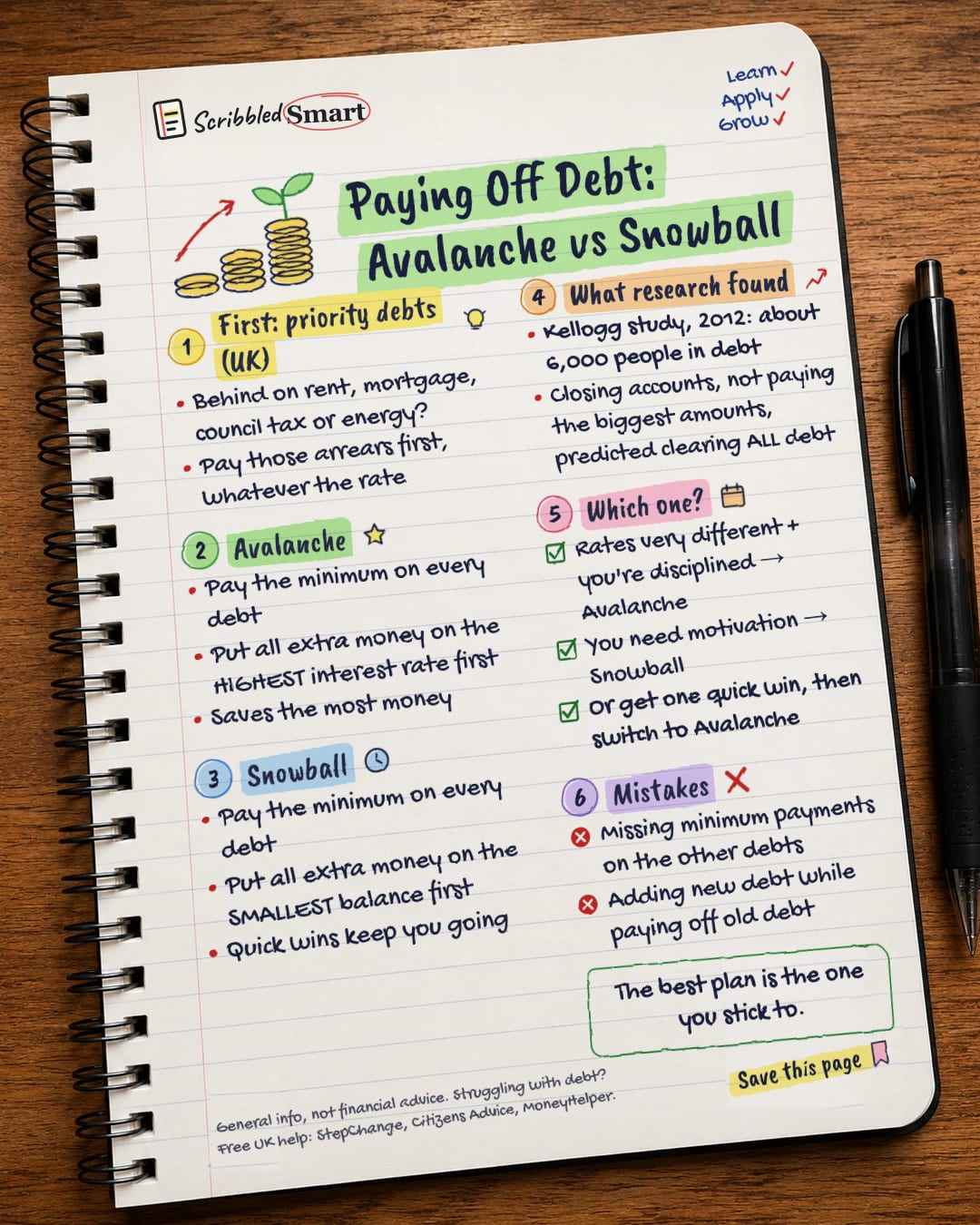
Debt avalanche vs snowball is a choice between two ways to pay off several debts. With both, you pay the minimum on everything, then put all your spare money on one debt. Avalanche targets the highest interest rate first and saves the most money. Snowball targets the smallest balance first and gives you quick wins to keep you going. Below is how each one works, a worked example, what research found, and how to pick.
Behind on rent, council tax or energy? Deal with those first
🇬🇧 Avalanche and snowball are ways to clear everyday debts like cards and loans. UK debt charity National Debtline says "priority debts are dealt with first". Its examples are arrears (missed payments) on your mortgage or rent, gas, electricity and council tax. Only the money left over after that goes to your other debts. So if you're behind on any of these, sort them out before you pick a method, and get free help (see below).
How does the debt avalanche method work?
- List every debt with its interest rate.
- Pay the minimum on all of them.
- Put every extra pound on the debt with the highest interest rate.
- When it's cleared, move that money to the next-highest rate.
Because the most expensive debt shrinks first, you pay less interest overall. Money Crashers, Benzinga and Tiller all agree on this. It's simple maths. UK debt charity StepChange gives the same advice: "Focus on eliminating high-interest debts first."
"Most expensive" means the highest interest rate, not the biggest balance. When a working group for HM Treasury and the FCA tested the tip "Pay off your most expensive debt first", it found "some confusion over whether the most expensive debt was the largest debt".
How does the debt snowball method work?
- List every debt by balance, smallest to largest.
- Pay the minimum on all of them.
- Put every extra pound on the smallest balance.
- When it's gone, roll that payment into the next-smallest. The payment "snowballs" as it grows.
You usually close your first account quickly. That early win can be a big motivation boost.
Debt avalanche vs snowball: a worked example
Say you have £150 a month to pay off two debts:
- A £2,000 credit card at 24% a year (minimum £40 a month)
- A £600 loan at 8% a year (minimum £20 a month)
We worked this out month by month (interest added monthly, minimums paid on both, the rest to the target debt):
| Avalanche (card first) | Snowball (loan first) | |
|---|---|---|
| First debt cleared | Month 19 | Month 6 |
| Debt-free | 21 months | 22 months |
| Total interest | £473.36 | £585.58 |
Avalanche saves about £112 and a month in this example. Snowball gives you a win 13 months sooner. Real numbers will differ, because minimum payments usually fall as balances fall and rates change. But the trade-off is the same.
The gap comes from compound interest: the 24% card grows fastest while you leave it. Our compound interest guide shows why high rates add up so quickly.
What the research found
In 2012, researchers Gal and McShane published a study in the Journal of Marketing Research. The Kellogg School of Management wrote it up. They looked at data from a debt settlement company covering about 6,000 people.
The main finding: closing debt accounts, regardless of the size of the balances closed, predicted who went on to clear all their debt. Paying off the biggest amounts did not. Small wins seem to help people keep going.
The Kellogg write-up is honest about the downside too. The snowball approach "doesn't make the best economic sense", because you pay more interest.
Limits of the study
- It studied people in a debt settlement programme, which is not everyone with debt.
- Some news coverage quotes exact percentages. The Kellogg page we read gives none, so we don't either.
- Kellogg commentary suggests the snowball's advantage matters most when interest rates are close together. In our example, with rates of 24% and 8%, snowball cost about £112 more in interest.
Which method should you choose?
- ✅ Rates very different, and you're disciplined? Choose avalanche.
- ✅ Need motivation to keep going? Choose snowball.
- ✅ Want both? Get one quick win, then switch to avalanche. This hybrid is a common suggestion from finance writers such as Credit.com. It's advice, not research.
Either way, the extra money has to come from somewhere. The savings pot of the 50/30/20 budget is a good place to start.
Common mistakes to avoid
- ❌ Missing minimum payments on the other debts. Always pay every minimum. StepChange explains that "all missed payments are recorded" on your credit file, and in the UK missed payments stay there for 6 years. A default shows for six years from the date it's first registered.
- ❌ Adding new debt while paying off old debt. It cancels out your progress. StepChange's advice: "avoid adding new charges while you are paying down your balance".
Free debt help in the UK
If debt feels unmanageable, you don't have to work it out alone. These UK services give free help:
- StepChange
- Citizens Advice
- MoneyHelper
FAQ
Is the debt avalanche or snowball better?
Avalanche saves the most money, because you clear the highest-interest debt first. Snowball gives faster wins, because you clear the smallest balance first. Research from Kellogg (2012) found that closing accounts predicted who cleared all their debt. So snowball can work well if you need motivation.
Does the snowball method cost more?
Usually, yes. Paying smaller balances first means your highest-rate debt keeps growing for longer. In our worked example, snowball cost about £112 more in interest than avalanche. The Kellogg write-up notes the approach "doesn't make the best economic sense", even though it may help people stick with their plan.
What did the Kellogg debt study find?
The 2012 study by Gal and McShane looked at about 6,000 people in a debt settlement programme. People who closed more accounts were more likely to clear all their debt, regardless of how large the closed balances were. The study only covered people in that programme.
Can you combine the avalanche and snowball methods?
Yes. A common suggestion is to clear one small debt first for a quick win, then switch to paying the highest rate first. It's practical advice from finance writers rather than a research finding. Keep paying every minimum whatever you choose.
Where can I get free debt help in the UK?
StepChange, Citizens Advice and MoneyHelper all offer free help with debt in the UK.
Related reading
- How credit scores work: why missed minimums hurt for years.
- Compound interest explained: why high-rate debt grows fast.
- The 50/30/20 budget rule: find the extra money to pay debts.
- How motivation really works: why quick wins keep you going.
Sources
- National Debtline: How to manage debt: a step-by-step plan to get back in control
- StepChange: Responsible use of credit (Get Credit Confident)
- StepChange: Default notices, missed payments and your credit file
- StepChange: How we work out debt repayments
- Financial Advice Working Group for HM Treasury and the FCA: Rules of Thumb and Nudges (2017)
- Kellogg School of Management: The snowball approach to debt (2012)
- CBS News: Study: To get out of debt, start small
- Money Crashers: Debt avalanche vs snowball
- Benzinga: Debt Avalanche vs. Debt Snowball
- Credit.com: Debt Snowball vs. Debt Avalanche
- Tiller: Best credit card payoff strategy
How we checked this
Every fact in this article comes from the 11 sources listed above, checked against official or peer-reviewed sources where possible. AI tools help with drafting; a person checks every fact against the sources. How we research
- Published and checked
General info, not financial advice. Struggling with debt? Free UK help: StepChange, Citizens Advice, MoneyHelper.
Spotted a mistake? Tell us and we'll fix it and log it on the corrections page.


